Signal · Live surveillance intelligence

What is happening right now

Verified developments in government surveillance — what changed, where, how well it is sourced, and what is still unknown. Every item carries its evidence and its gaps.

14 in the last 7 days · 14 in the last 30 · RSS

14 items

1d ago National ALPR Civic campaign

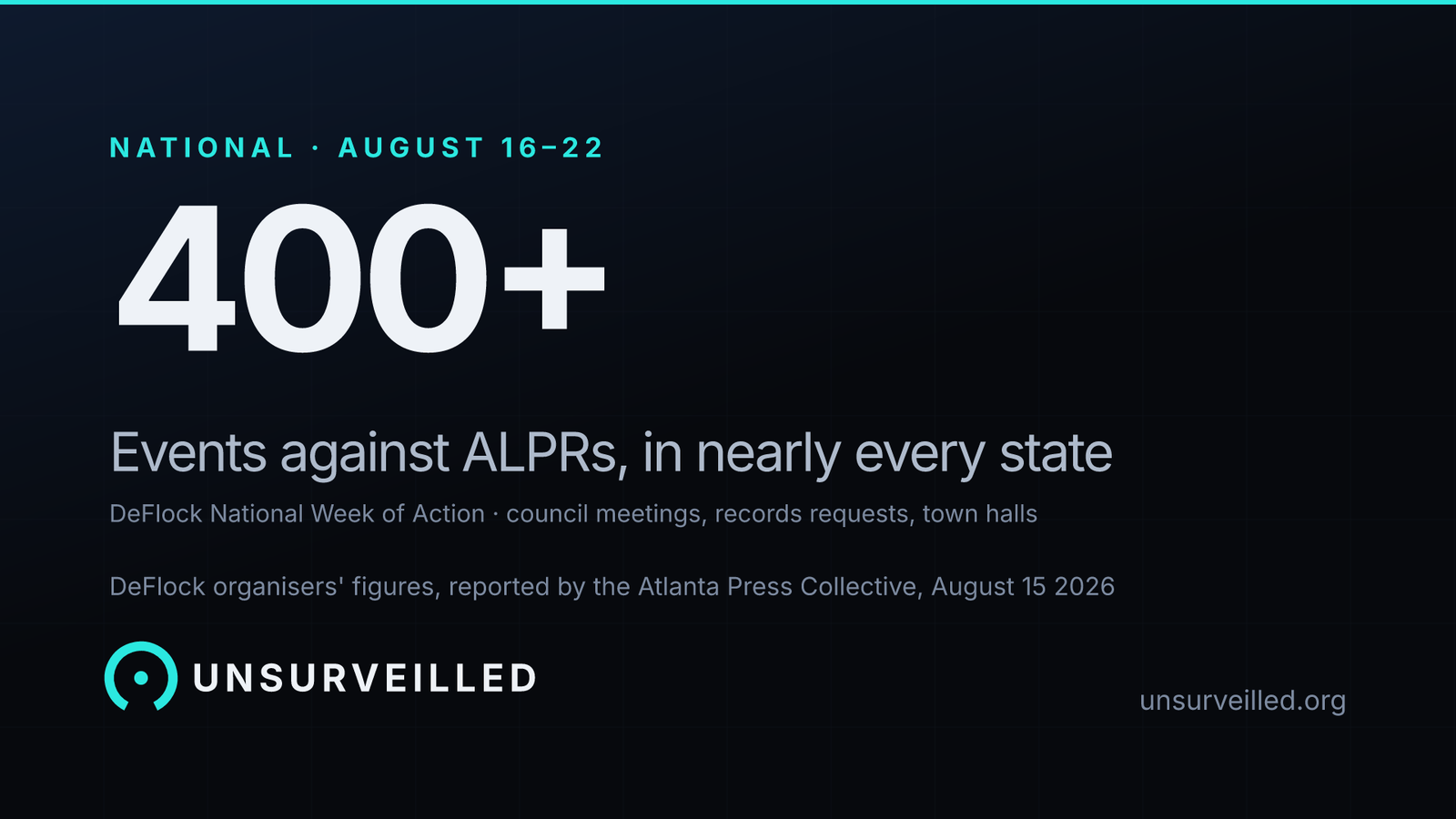
The national week of action against ALPRs runs August 16–22, and it is a civic one

More than 400 events in nearly every state, organised by DeFlock. Council meetings, records requests, information sessions. The organisers say plainly what it is not.

Why it matters This site exists to make local action possible, and for one week there is a national scaffold for it. Almost everything Unsurveilled publishes is designed to be used by a person acting alone — a records request, a dossier, a council question — and acting alone is slow and discouraging

Multiple sources

2d ago Arizona ALPR Public backlash

Arizona man arrested after bending Flock camera pole amid growing ALPR backlash

A Pinal County resident said he used his work truck to bend a license-plate reader pole so the camera pointed at the sky. He was arrested and faces a felony criminal-damage charge — in a state where two agencies have just walked away from their ALPR contracts.

Why it matters This is not an ALPR misuse case, and filing it as one would be wrong. Nothing here suggests the camera was abused; the event is public backlash directed at surveillance infrastructure, and an alleged crime committed in the course of it

Reported

2d ago Arizona ALPR Cancellation

Chandler shuts down 40 Flock cameras after an audit finds use it cannot explain

Three years of routine audits found nothing. The fourth found something. The largest Arizona city running Flock Safety cameras responded by revoking every officer's access and ending the program outright.

Why it matters The significant detail is not that misuse happened. It is that Chandler had been running audits for three years before one caught anything — and then that the city's response was to stop rather than to tighten controls and carry on

Official agency

2d ago National ALPR Vendor policy

Flock cuts default ALPR retention from 30 days to seven — and still does not require a warrant

The largest ALPR vendor in American policing announced real, substantial limits on its own product. It also left the one question this campaign is about exactly where it was.

Why it matters Take the retention change seriously: it is the single field that most changes what an ALPR system is, and cutting the default from 30 days to seven is a real reduction in the size of the movement archive. A company does not do that because things are going well

Primary document

2d ago Multi-state ALPR Intelligence monitoring

Fusion centers monitored anti-ALPR activists and circulated intelligence on planned events

Public-records reporting shows state and regional fusion centers monitoring publicly visible anti-Flock activity online and distributing intelligence products to law enforcement. Some material concerned vandalism. Other material tracked lawful organizing.

Why it matters Investigating vandalism is one thing. Treating lawful opposition to government surveillance as an intelligence subject is another

Reported

2d ago Virginia ALPR Lawsuit

The Norfolk plate-reader case is at the Fourth Circuit, and the whole question is scale

A district judge held that Norfolk's camera grid does not track the whole of a person's movements. Two residents whose cars were captured 475 and 325 times in four months have appealed.

Why it matters Nobody in this case argues that photographing one license plate on one public street is a search. The dispute is entirely about how many cameras, held for how long, searchable how far back, before a collection of individually unremarkable observations becomes something the Fourth Amendment recognises

Court documented

2d ago Minnesota ALPR Cancellation

Duluth and Sherburne County drop Flock — and Duluth keeps sixty license plate readers

Minnesota's largest Flock cancellation to date is also the clearest reminder that ending a vendor contract and ending automated plate reading are not the same decision.

Why it matters Take the win, then read the second paragraph. Duluth ended a contract with the vendor whose name is on every one of these fights, and that is real — it is the largest such decision in Minnesota so far, and organisers there earned it

Reported

2d ago Arizona ALPR Cancellation

Pinal County sheriff declines to renew Flock contract, citing the Fourth Amendment

Roughly 45 cameras, about half of them in San Tan Valley — a town that incorporated five weeks earlier and now gets to decide its own surveillance policy before a contract exists to defend.

Why it matters A sheriff declining a surveillance tool on Fourth Amendment grounds — rather than on cost, performance, or a procurement dispute — is unusual, and it is an argument that travels well to neighbouring jurisdictions in a way that a budget complaint never does. The timing compounds it

Reported

2d ago Minnesota ALPR Data sharing

Around thirty agencies searched Twin Cities plate-reader data for immigration enforcement

Eight Minnesota suburbs left their camera networks open. During a federal operation last winter, agencies from inside and outside the state searched that data for civil immigration purposes.

Why it matters This is what a sharing default does. Not one of these suburbs decided to help with immigration enforcement; several say the searches were a use their program was never meant to serve

Reported

2d ago National ALPR Court ruling

Supreme Court holds digital location history is protected — and says nothing about license plate readers

Chatrie v. United States is the most important Fourth Amendment decision in eight years. It is also not the ALPR ruling some coverage is treating it as, and the difference matters if you are about to quote it to a city council.

Why it matters The reasoning is what makes this consequential rather than the outcome. The Court looked at the retrospective and indiscriminate character of the collection and at what sat in the database as a whole, not merely at the narrow slice police actually pulled

Court documented

2d ago Washington ALPR Legislation

Washington's ALPR law is the strictest in the country, and it is already in force

Twenty-one day deletion, a bar on federal and out-of-state access to publicly owned camera data, prohibited locations, and a private right to sue. It took effect the day it was signed.

Why it matters Every fight this site covers is a fight over four fields — how long the data is kept, who can search it, where the cameras may point, and what happens when somebody breaks the rules. Washington is the first state to legislate all four at once, and the fourth one is the one nobody else has done

Primary document

Coverage is incomplete and always will be. Signal records what Unsurveilled can responsibly discover and verify, not everything that happens. If something is missing, tell us — leads are how most of this starts. Read how items are sourced and tiered.