The ACLU's national ALPR campaign puts a number on Flock. We can check it.

Get the Flock Out coordinates state affiliates, model legislation, and litigation. It also publishes figures — and one of them is testable against our own map.

Multiple sources — what does this mean?

Independently reported by more than one outlet, with no primary document in our hands yet.

Event: Published:
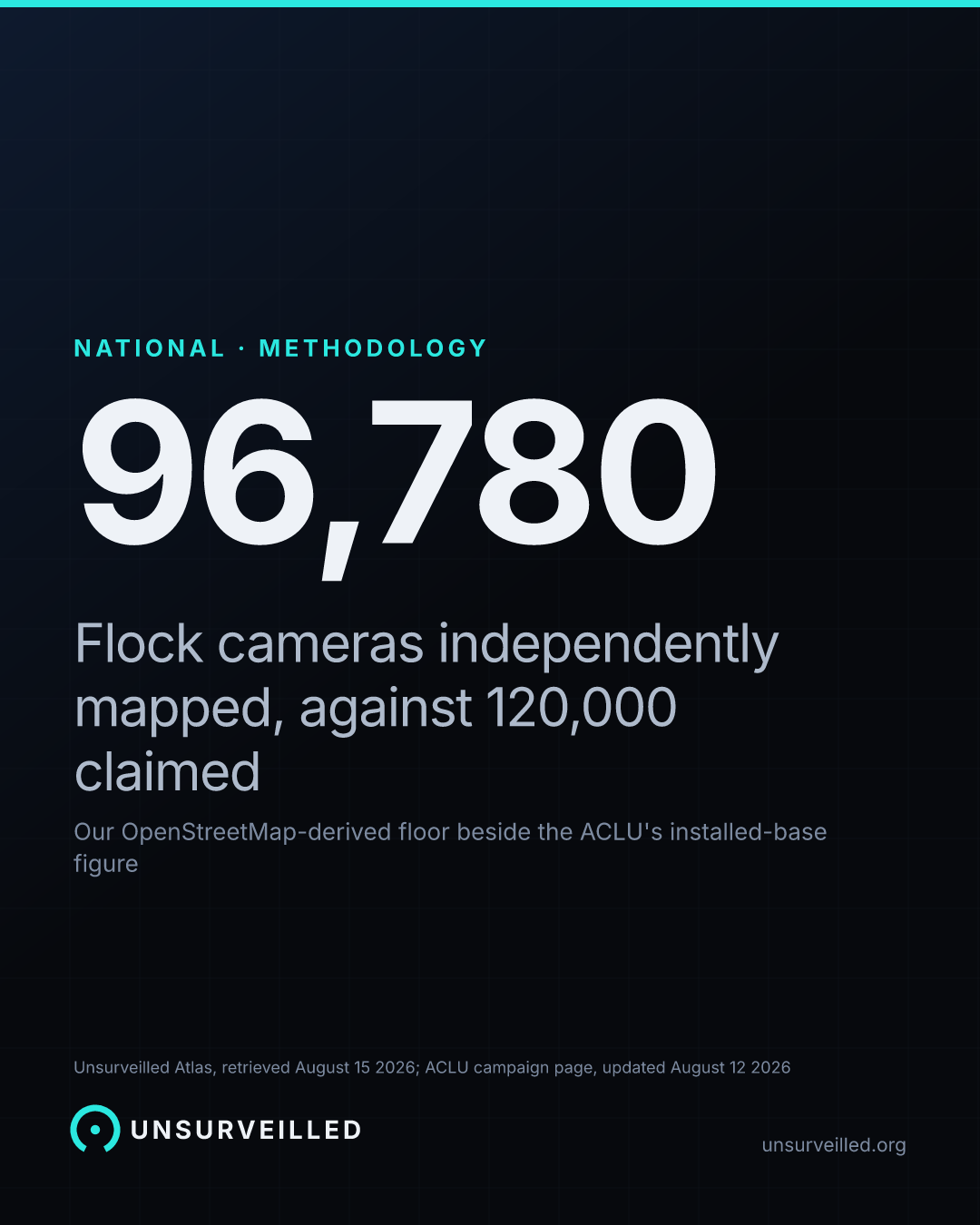
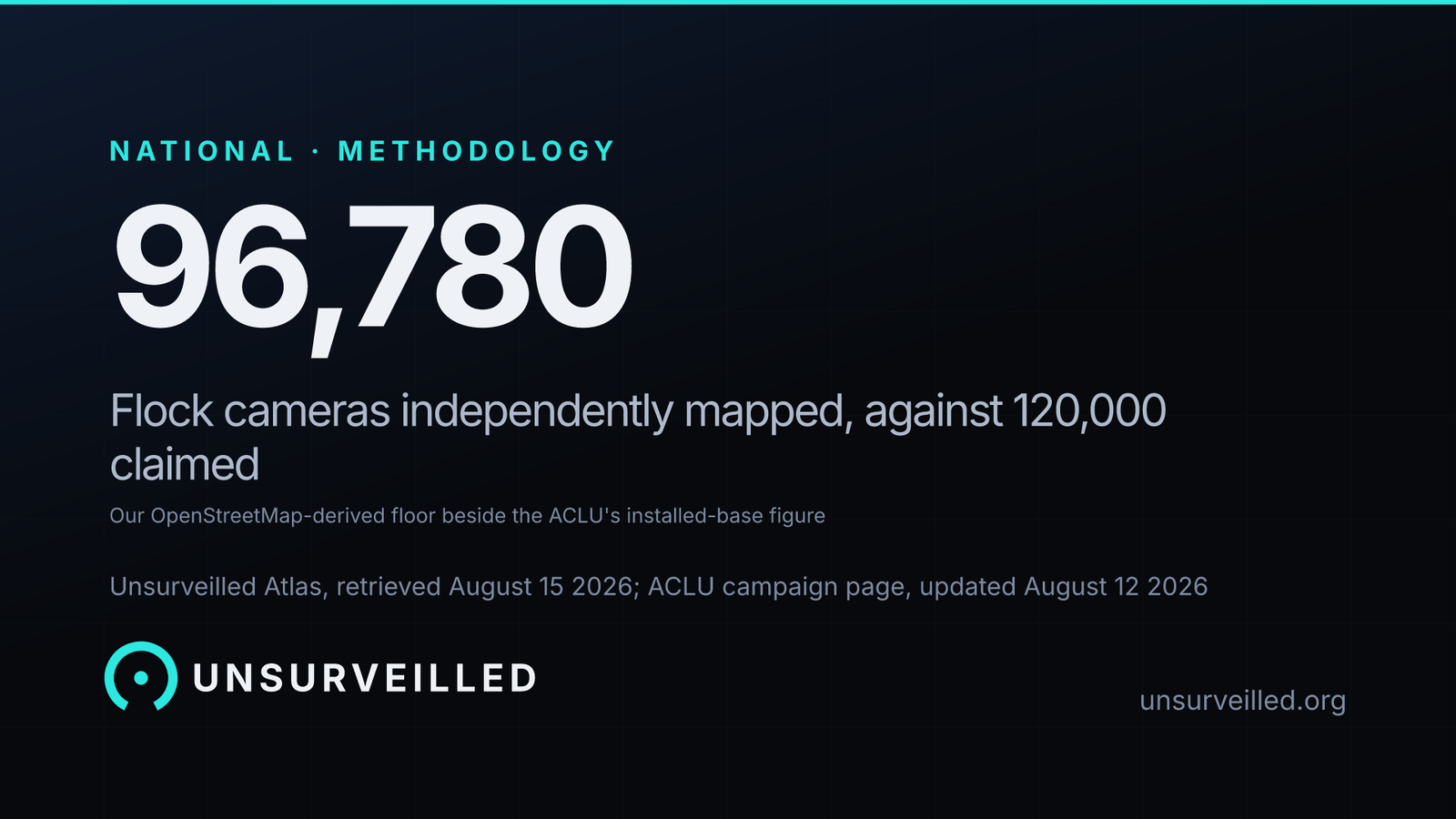
Dark graphic reading 96,780 above the line "Flock cameras independently mapped, against 120,000 claimed", with a smaller line reading "Our OpenStreetMap-derived floor beside the ACLU's installed-base figure".
Unsurveilled graphic, generated from this record. Unsurveilled Atlas, retrieved August 15 2026; ACLU campaign page, updated August 12 2026. Download the 4:5 version.

What happened

The ACLU launched Get the Flock Out in June 2026, a national campaign coordinating the litigation, advocacy and legislative work of its state affiliates on automated license plate readers. The campaign released model ALPR legislation in February 2026, filed an amicus brief in Schmidt v. City of Norfolk in April 2026, and supported a bipartisan amendment to the federal highway funding bill in May 2026 that would have restricted ALPR use except for tolling. Affiliates including the ACLU of Massachusetts and the ACLU of Indiana have published organising toolkits containing public-records request templates and a model surveillance-oversight ordinance. The national campaign page, updated August 12, 2026, states that 120,000 Flock cameras are installed, that fewer than 1% of scanned vehicles are connected to crimes, and that roughly one in ten plates is misread.

Why it matters

Two things are worth saying about this campaign, and the second matters more to how this site works. The first is that it is the missing piece structurally. Individual councils have been fighting these systems one at a time, which is how you get Binghamton — a majority vote that cannot reach the contract. A campaign that pairs local organising with model legislation, appellate amicus work, and a federal amendment is aimed at the levels where the decision actually sits. The second is that the ACLU publishes numbers, and we can test one of them, and we should. Its figure of 120,000 installed Flock cameras sits next to our own count of 96,780 Flock-attributed camera coordinates mapped by OpenStreetMap volunteers. Those are not in conflict — ours is a floor built from what somebody physically recorded, theirs is a claim about an installed base — and the fact that a crowd-sourced map independently reaches roughly four-fifths of the asserted total is the most useful thing either number can tell you. We would say so if it went the other way. An organisation we agree with is not exempt from the sourcing standard, and treating allies' figures as automatically established is precisely how a research project stops being one.

At a glance

Sourcing
Multiple sources — Independently reported by more than one outlet, with no primary document in our hands yet.
Story type
Civic campaign
Vendor
Flock Safety
Open questions
4 unresolved

What is established

  • Documented

    The ACLU launched the Get the Flock Out campaign in June 2026 to coordinate the litigation, advocacy and legislative work of its state affiliates on automated license plate readers.

    American Civil Liberties Union

  • Documented

    The ACLU released model ALPR legislation in February 2026.

    American Civil Liberties Union

  • Documented

    The ACLU filed an amicus brief in Schmidt v. City of Norfolk in the Fourth Circuit in April 2026.

    American Civil Liberties UnionElectronic Privacy Information Center

  • Documented

    The ACLU supported a bipartisan amendment to the federal highway funding bill in May 2026 that would have restricted state and local ALPR use except for tolling purposes.

    American Civil Liberties Union

  • Documented

    The ACLU of Massachusetts published a community advocacy toolkit containing public-records request templates and a model surveillance-oversight ordinance.

    ACLU of Massachusetts

  • Documented

    Unsurveilled's own camera layer holds 96,780 coordinates attributed to Flock Safety by OpenStreetMap contributors, out of 118,623 ALPR coordinates across all vendors.

What is disputed, contested, or being read too far

  • Official claim

    The campaign states that 120,000 Flock cameras are installed. That is an advocacy organisation's figure and we have not seen its derivation. It is compatible with our own mapped count of 96,780 Flock-attributed coordinates, which is a floor rather than an inventory — a camera nobody has walked past and recorded does not appear on our map. We cite the ACLU's number as the ACLU's number.

    American Civil Liberties Union

  • Official claim

    The campaign states that fewer than 1% of scanned vehicles are connected to crimes and that roughly one in ten plates is misread. We have not obtained the underlying studies or audit data for either figure, and we do not repeat them as established. Both are the kind of claim that would be straightforward to verify from agency audit logs, which is a reason to request them rather than a reason to assume.

    American Civil Liberties Union

  • Unsurveilled analysis

    The ACLU is a party and an advocate in several of the matters it reports on. That does not make its factual claims wrong, and it does mean they are positions rather than findings. We apply the same rule to Flock's claims about its own product, and to our own.

What the campaign is

The ACLU launched Get the Flock Out in June 2026. It coordinates what had been fifty separate efforts: the litigation, advocacy and legislative work of state affiliates on automated license plate readers.

The concrete pieces so far:

  • Model ALPR legislation, released February 2026.
  • An amicus brief in Schmidt v. City of Norfolk in the Fourth Circuit, April 2026, filed with the ACLU of Virginia and the Electronic Frontier Foundation.
  • Support for a bipartisan amendment to the federal highway funding bill in May 2026, which would have restricted state and local ALPR use except for tolling.
  • Affiliate toolkits, including from the ACLU of Massachusetts and the ACLU of Indiana, carrying public-records request templates and a model surveillance-oversight ordinance.

Why the structure matters more than the branding

Read this against Binghamton, where a city council voted to end its contracts and then discovered it had no authority to do so.

That is not a Binghamton problem. It is the general shape of the thing. A local campaign spends months building to a council vote, and the decision turns out to sit with a mayor, or in an auto-renewal clause, or in a state statute that preempts the ordinance, or in a regional database the city can query without owning a single camera.

A campaign that runs model legislation, appellate briefs and a federal amendment alongside local organising is aimed at where the decision actually is. It is also, frankly, the thing a volunteer project like this one cannot do, and it is useful to say so.

The toolkits are the part most readers can use tomorrow. A model surveillance-oversight ordinance is the difference between a council that has to be persuaded about each new system and one that has a standing process — which is criterion seven of the Verified Unsurveilled standard, and the one most communities fail on.

The number we can check

The campaign page states that 120,000 Flock cameras are installed.

Our own Atlas holds 96,780 camera coordinates attributed to Flock Safety by OpenStreetMap contributors, out of 118,623 ALPR coordinates across all vendors.

These do not contradict each other, and the comparison is genuinely informative:

  • Ours is a floor. It counts cameras somebody physically observed and recorded. A camera nobody has walked past does not exist on our map. We say this on every page the number appears on, and it is the reason the Atlas header reads COVERAGE INCOMPLETE at every zoom level.
  • Theirs is a claim about an installed base, of a kind we have not seen the derivation for.

An independent, crowd-sourced, volunteer-built count landing at roughly four-fifths of an advocacy organisation’s asserted total is a meaningful corroboration in both directions. It suggests the ACLU’s figure is not inflated, and it suggests our map is more complete than a project of this size has any right to expect.

We would publish that comparison if it came out the other way.

The two figures we are not repeating

The campaign also states that fewer than 1% of scanned vehicles are connected to crimes, and that roughly one in ten plates is misread.

We have not obtained the underlying studies or audit data for either, so we cite them as the ACLU’s claims and not as established facts. Both would strengthen the argument considerably if they hold, which is exactly why they should be sourced before they are repeated by anyone.

Both are also, notably, the kind of thing an agency’s own audit logs would answer. A hit-rate figure is a query against a system that already records every search and every alert. That makes it a records request rather than a research project, and it is on our open questions list for that reason.

The standard cuts both ways

An organisation we agree with does not get a pass.

We apply the same rule to Flock’s statements about its own product — the company is authoritative about what it says its software does, and not about whether that is sufficient. We applied it to a council member’s claim about how many municipalities have cancelled, and we would rather publish our own smaller confirmed number. We apply it to the ACLU here.

We also apply it to ourselves, which is why the Flock figure above is labelled a floor everywhere it appears and why the states with no data on our map are listed by name rather than left blank.

Treating an ally’s statistics as automatically established is how a research project stops being one. The value of this site is that a city attorney can check it.

What this changes for a resident

Two things worth doing:

  1. Find your affiliate’s toolkit. Several states now have one. The public-records templates in them are jurisdiction-tuned in a way our generic generator is not.
  2. Ask your agency for its hit rate. Not the vendor’s national figure — yours. How many searches, how many alerts, how many led to a charge. That number exists in the audit log, and a city that cannot produce it has told you something about its oversight.

Our records request generator covers the second one.

Receipts

Multiple sources — what does this mean?

Independently reported by more than one outlet, with no primary document in our hands yet.

  • Brief of amicus curiae EPIC, Schmidt v. City of Norfolk, No. 26-1227Electronic Privacy Information CenterA filed brief in the Fourth Circuit appeal, which establishes the docket number and that the appeal is being briefed. An amicus brief is advocacy: it establishes what a party argued, never that the argument is correct.Court filing
  • Fight creepy ALPR camerasAmerican Civil Liberties UnionThe ACLU's national campaign page. Authoritative for what the ACLU is doing and asking for — model legislation, affiliate toolkits, amicus filings, federal advocacy. The statistics it publishes, including an installed-base figure for Flock cameras and claimed hit rates, are the organisation's claims and are cited as such rather than as established counts. It is advocacy material by a party to several of the matters it describes.NGO research
  • Get the FLOCK Out — community advocacy toolkitACLU of MassachusettsAn affiliate organising toolkit containing public-records request templates and a model surveillance-oversight ordinance. Establishes what the ACLU is asking communities to do. It is advocacy material and is not evidence about any particular jurisdiction.NGO research
  • As public opposition to Flock grows, ACLU responds to surveillance company new updatesAmerican Civil Liberties UnionThe ACLU assessment of the August 2026 Flock platform changes. Establishes the organisation position; the factual claims inside it about Flock product behaviour rest on Flock own announcement.NGO research

Not yet obtained

  • How does the ACLU derive its figure of 120,000 installed Flock cameras?Vendor disclosure
  • What data underlies the claims about crime-connection rates and misread rates?Public-records request
  • Which states have introduced bills based on the ACLU model legislation, and what became of them?Council agenda
  • What became of the May 2026 federal highway bill amendment?Public-records request

Verified as of

Do this in your town

Find your state affiliate’s toolkit

Several states now have jurisdiction-tuned records templates and a model ordinance. They are more specific than any generic generator can be.

Questions this story leaves open

  • How does the ACLU derive its figure of 120,000 installed Flock cameras?
  • What data underlies the claims about crime-connection rates and misread rates?
  • Which states have introduced bills based on the ACLU model legislation, and what became of them?
This Unsurveilled record is licensed CC BY 4.0. Linked source material remains the property of its publishers. Spotted an error? Tell us — corrections are logged in public, not quietly edited away.