Around 30 agencies searched Twin Cities plate-reader data for immigration enforcement last winter. None of those suburbs voted for that. They voted — or didn't vote at all — on leaving the network open. Sharing defaults are the decision nobody debates and everybody lives with.
Around thirty agencies searched Twin Cities plate-reader data for immigration enforcement
Eight Minnesota suburbs left their camera networks open. During a federal operation last winter, agencies from inside and outside the state searched that data for civil immigration purposes.
Reported — what does this mean?
Reported by a named outlet and not contradicted, but we have not obtained the underlying record. Specifics are presented as reported, not as established.
What happened
A Minnesota Star Tribune investigation published on July 20, 2026 reported that roughly thirty state, county and federal agencies searched automated license plate reader data held by at least eight Twin Cities suburbs for immigration-enforcement purposes between November and March, during the federal operation known as Metro Surge. The suburbs named were Fridley, Eagan, South St. Paul, Crystal, Robbinsdale, Brooklyn Center, Hopkins and Shakopee. The Mille Lacs County Sheriff's Office was identified as one of the searching agencies. Fridley, which held the most-searched network, later told its council that immigration-related searches of its cameras fell from 107 in January 2026 to zero in February after it restricted access to Minnesota agencies and disabled immigration searches.
Why it matters
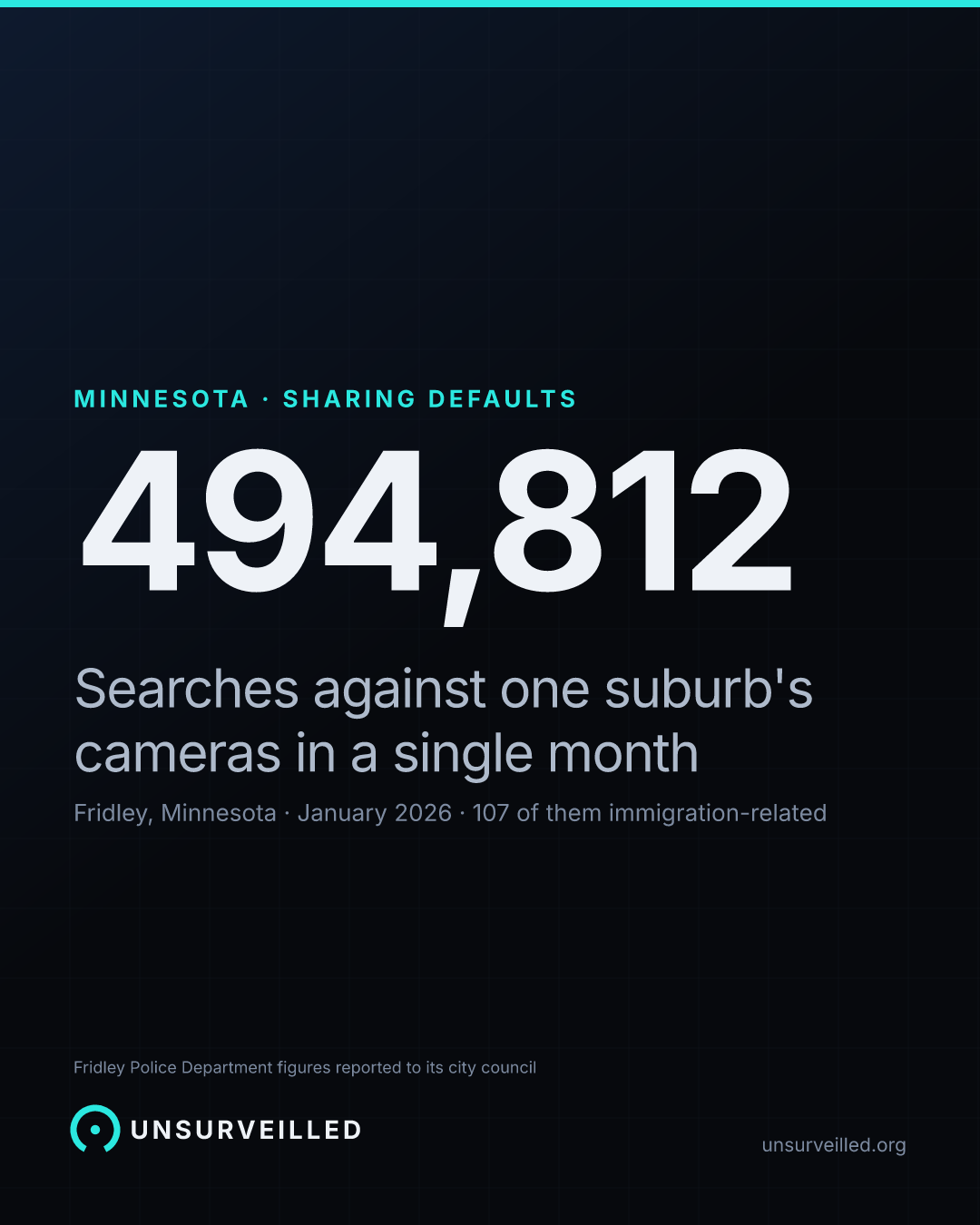
This is what a sharing default does. Not one of these suburbs decided to help with immigration enforcement; several say the searches were a use their program was never meant to serve. They decided something far more ordinary — to leave the network open, because openness is how the product is sold and how it is configured out of the box. Everything that followed was a consequence of a checkbox nobody debated at a council meeting. The Fridley figures are worth sitting with for a moment: 494,812 searches against one small city's cameras in a single month, of which 107 were immigration-related. The immigration searches are the story that broke, but the half-million is the system working exactly as designed. Retention determines how far back someone can look. Sharing determines who is looking. A city can win a hard-fought fight over retention and still have handed the entire archive to agencies whose names never appeared on any agenda. That is why every dossier on this site carries outbound sharing as its own field, and why "not established" is printed in full rather than left blank.
At a glance
- Sourcing
- Reported — Reported by a named outlet and not contradicted, but we have not obtained the underlying record. Specifics are presented as reported, not as established.
- Story type
- Data sharing
- Technology
- Automated license plate readers
- Vendor
- Flock Safety
- Open questions
- 5 unresolved
What is established
- Documented
The Minnesota Star Tribune reported on July 20, 2026 that around thirty state, county and federal agencies searched camera data held by at least eight Twin Cities suburbs for immigration-enforcement purposes between November and March.
- Documented
The suburbs identified were Fridley, Eagan, South St. Paul, Crystal, Robbinsdale, Brooklyn Center, Hopkins and Shakopee.
- Documented
The Mille Lacs County Sheriff's Office was identified as one of the agencies that searched Twin Cities suburban camera data for civil immigration purposes.
- Official claim
The Fridley Police Department reported 107 immigration-related searches against its cameras in January 2026 and zero in February 2026.
- Official claim
The Fridley Police Department reported 494,812 total searches against its cameras in January 2026, falling to 22,480 in February 2026 after access was restricted to Minnesota agencies.
- Official claim
Fridley Deputy Director Patrick Faber stated that before February 2026 the city's network was open to out-of-state law-enforcement agencies and was searched heavily, and that some of that access was used for immigration-related searches, a purpose the program was never meant to serve.
- Official claim
Some local law-enforcement officials told the Star Tribune that civil immigration searches do not fit their understanding of a lawful use of license plate reader data in Minnesota.
What is disputed, contested, or being read too far
- Unsurveilled analysis
Whether any individual search violated Minnesota law is not established here. Reporting describes state law as permitting ALPR data to be shared in support of an active criminal investigation, and civil immigration enforcement is not a criminal investigation — but Unsurveilled has not reviewed the statute against these specific searches, and no court or state authority has ruled on them. We record what the records show and what officials said about it, and we stop there.
- Unsurveilled analysis
The Fridley search totals are the department's own account of its audit data, presented to its council. They are the best figures publicly available and they have not been independently examined by anyone outside the department, including us.
What the records show
On July 20, 2026, the Minnesota Star Tribune published an investigation built on automated license plate reader audit records. It reported that roughly thirty state, county and federal agencies searched camera data held by at least eight Twin Cities suburbs for immigration-enforcement purposes between November and March, during the federal operation known as Metro Surge.
The suburbs named were Fridley, Eagan, South St. Paul, Crystal, Robbinsdale, Brooklyn Center, Hopkins and Shakopee. The Mille Lacs County Sheriff’s Office was identified as one of the searching agencies.
None of these places is a border town. None of them adopted a policy of assisting immigration enforcement. What they did was leave the sharing configuration open — which is the configuration these networks arrive in, and which is the feature the product is sold on.
The Fridley numbers
Fridley held the most heavily searched of the networks, and in late July its police department put figures in front of its own city council. They are the clearest picture anyone has published of what an open ALPR network actually does.
| Month | Immigration-related searches | Total searches |
|---|---|---|
| January 2026 | 107 | 494,812 |
| February 2026 | 0 | 22,480 |
Between those two months the department restricted network access to Minnesota agencies and disabled immigration-related searching. Deputy Director Patrick Faber told the council that before February the network had been open to out-of-state law enforcement and was searched heavily, and that some of that access was used for immigration-related searches — “a purpose the program was never meant to serve.”
Read the right-hand column again. The immigration searches are why this became a story. The half-million is what the system does on an ordinary month with the door open, and nothing about that number was a scandal to anybody until somebody printed it.
What we are not saying
We are not saying any of these searches was unlawful. Reporting describes Minnesota law as permitting ALPR data to be shared in support of an active criminal investigation, and civil immigration enforcement is not a criminal investigation. Several local officials told the Star Tribune that these searches do not fit their understanding of lawful use.
That is officials’ characterisation of the law and of their own programs. It is not a ruling, and we have not put the statute against these specific searches ourselves. The distinction matters enough to state plainly: what is documented is that the searches happened and that officials were surprised by them. Whether any of them broke the law is an open question we have listed above, and it is the kind that gets answered by a court or an attorney general, not by us.
Why the sharing field exists
Every jurisdiction dossier on this site carries outbound sharing as its own field, next to retention, and prints “not established” when we do not know. People sometimes ask why we do not simply fold it into a general “privacy policy” summary.
This is why.
Retention answers how far back can someone look. Sharing answers who is looking. They are independent, and a community can fight hard for one while handing over the other without noticing. A city that cuts retention to seven days and leaves its network open to anyone with a login has reduced the depth of the archive and not touched its reach. Fridley’s own figures show the reach shrinking by 95% the month it closed the door — no cameras removed, no contract cancelled, no retention change.
That is the cheapest surveillance reform available to any council in the country, and most of them have never been asked for it.
What this changes for a resident
If your city runs ALPR cameras, three questions belong in writing to your council this month:
- Which outside agencies can currently search our camera data? Ask for the list, not for a reassurance.
- How many searches were run against our cameras in the last full month, by whom, and under what stated reason? Fridley’s figures existed all along. Somebody asked for them.
- What would it take to restrict access to in-state agencies with a documented criminal case? In Fridley that change took weeks and cost nothing.
The records request generator produces all three. If you get an answer, send it to us — a sharing configuration is exactly the kind of fact that turns a decision record into a dossier.
Receipts
Reported — what does this mean?
Reported by a named outlet and not contradicted, but we have not obtained the underlying record. Specifics are presented as reported, not as established.
- Police searched Twin Cities license plate cameras for immigration enforcement during ICE surgeInvestigative reporting built on ALPR audit records. Establishes that around thirty state, county and federal agencies searched camera data held by at least eight Twin Cities suburbs for immigration-enforcement purposes between November and March, during the federal operation known as Metro Surge, and that Minnesota law limits sharing of ALPR data to active criminal investigations. It does not establish that any particular search was unlawful — that is a legal conclusion no outlet has authority to reach — and Unsurveilled does not hold the underlying audit logs.Local reporting
- Feds checked these suburbs Flock cameras for immigration casesSecondary coverage of the Star Tribune investigation. Names the suburbs whose camera data was searched — Fridley, Eagan, South St. Paul, Crystal, Robbinsdale, Brooklyn Center, Hopkins and Shakopee — and identifies the Mille Lacs County Sheriff Office as one searching agency. It does not itemise searches by agency or by suburb.Local reporting
- Fridley police detail who can access Flock Safety camera data amid concerns from residentsReports figures the Fridley Police Department presented publicly: 107 immigration-related searches and 494,812 searches in total against Fridley cameras in January 2026, falling to zero and 22,480 in February 2026 after the department restricted its network to Minnesota agencies. Quotes Deputy Director Patrick Faber. The figures are the department own account of its audit data; Unsurveilled has not obtained the logs behind them.Local reporting
- Flock camera debate continues in Fridley as officials explain data access changesContemporaneous coverage of the Fridley City Council meeting at which the police department explained the access changes. Corroborates the timing of the restrictions; adds no independent figures.Local reporting
Not yet obtained
- How many immigration-related searches were run against the other seven suburbs, and by which agencies?Public-records request
- What became of the data returned by those searches, and was any of it retained by the searching agencies?Public-records request
- Which Minnesota agencies still permit out-of-state or federal network access today?Public-records request
- Did any of the searches produce an enforcement action against an identified person?Public-records request
- Does Minnesota law as written permit a civil immigration search of ALPR data, and has any state authority said so?Court record
Verified as of
Do this in your town
Ask which outside agencies can search your city’s data
Sharing configurations are set once, usually by nobody in public. Ask for the list of agencies with access, not for a reassurance that it is limited.
Questions this story leaves open
- How many immigration-related searches were run against the other seven suburbs, and by which agencies?
- What became of the data returned by those searches, and was any of it retained by the searching agencies?
- Which Minnesota agencies still permit out-of-state or federal network access today?
This Unsurveilled record is licensed CC BY 4.0. Linked source material remains the property of its publishers. Spotted an error? Tell us — corrections are logged in public, not quietly edited away.