Binghamton's council voted to end its Flock contracts. It has no power to do it.

A resolution is not a cancellation. In Binghamton the authority sits with the mayor, the mayor has said no, and one of the contracts renews automatically this month.

Reported — what does this mean?

Reported by a named outlet and not contradicted, but we have not obtained the underlying record. Specifics are presented as reported, not as established.

Event: Published:
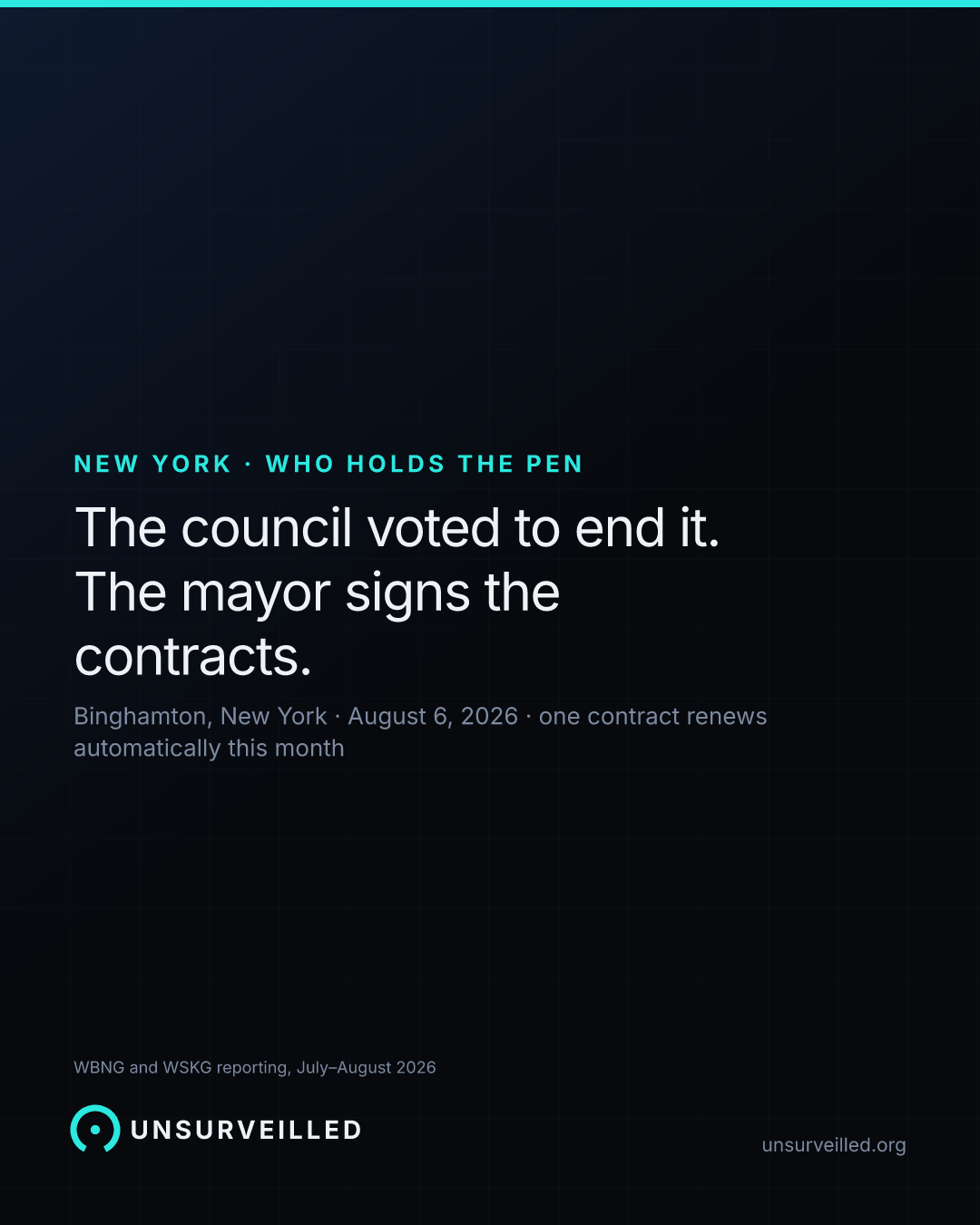
Dark graphic reading "The council voted to end it. The mayor signs the contracts.", with a smaller line reading "Binghamton, New York, August 6, 2026, one contract renews automatically this month".
Unsurveilled graphic, generated from this record. WBNG and WSKG reporting, July–August 2026. Download the 4:5 version.

What happened

On August 6, 2026 the Binghamton City Council adopted a resolution calling on Mayor Jared Kraham to terminate the city's contracts with Flock Safety, to refrain from new agreements until local policies are adopted, and supporting statewide privacy standards. Reporting on July 31 established that cancellation authority in Binghamton rests with the mayor rather than the council; Council Chair Michael Dundon said the council had no power over the renewal. Mayor Kraham has said the cameras are not going anywhere, and Deputy Mayor Megan Heiman described the technology as an indispensable resource. One Binghamton contract was reported as renewing automatically in August 2026, with a second up for possible renewal in January 2027.

Why it matters

This is the most useful failure case in the batch, and organisers everywhere should read it before their own council vote rather than after. Binghamton did everything that looks like winning. Committee discussion, public comment, a majority vote, a resolution that carefully concedes ALPRs can serve legitimate purposes and asks for transparency and safeguards rather than abolition. And the cameras will still be there next month, because in this city the power to sign and unsign a contract belongs to the executive, and no amount of legislative sentiment moves it. Worse, one of the contracts renews by itself. Nobody has to defend it, schedule it, or vote for it — the default is continuation, and the effort required to keep the cameras is zero while the effort required to remove them is a charter fight. That asymmetry is the actual mechanism by which surveillance infrastructure becomes permanent, and it is almost never what a campaign is aimed at. The lesson is not that resolutions are worthless. It is that the first question in any local ALPR campaign is who holds the pen, and the second is when the contract renews itself.

At a glance

Sourcing
Reported — Reported by a named outlet and not contradicted, but we have not obtained the underlying record. Specifics are presented as reported, not as established.
Story type
Public backlash
Vendor
Flock Safety
Open questions
5 unresolved

What is established

  • Documented

    On August 6, 2026 the Binghamton City Council adopted a resolution calling on Mayor Jared Kraham to terminate the city's Flock Safety contracts and to refrain from new agreements until comprehensive local policies are adopted.

    WBNG

  • Documented

    The resolution acknowledges that automated license plate readers can serve legitimate public-safety purposes, and asks for transparency, accountability and safeguards rather than prohibition.

    WBNG

  • Documented

    Authority to cancel the Flock contracts rests with the mayor rather than the city council.

    WSKG

  • Official claim

    Council Chair Michael Dundon said the council was looking for any option it had on the renewal but had no power over it.

    WSKG

  • Official claim

    Deputy Mayor Megan Heiman said the city's ALPR technology has proven to be an indispensable resource for the Binghamton Police.

    WSKG

  • Documented

    One Binghamton Flock contract was reported as renewing automatically in August 2026, with a second up for possible renewal in January 2027.

    WSKG

  • Official claim

    Mayor Kraham has stated he does not intend to terminate the contracts, and has said the technology contributed to a reduction in crime in Binghamton.

    WBNG

What is disputed, contested, or being read too far

  • Official claim

    Council Majority Leader Rebecca Rathmell stated at the meeting that over 80 municipalities across 28 states have terminated automated license plate reader contracts. That is a claim made by an elected official in a council setting, not a figure Unsurveilled has verified. Our own Decision Record holds fewer, because it holds only what we have confirmed to a source. We cite her statement as her statement.

    WBNG

  • Official claim

    The mayor's statement that the technology contributed to a reduction in crime in Binghamton is an official claim about program effectiveness. No audit, study, or dataset supporting it has been published that we have seen, and no evaluation of a city ALPR program should be accepted or dismissed on an official's assertion alone.

    WBNG

  • Disputed

    The reported vote was 4–2 with one member absent. We cite the adoption of the resolution as established and treat the precise tally as pending the council's own minutes.

    WBNG

What happened

On August 6, 2026 the Binghamton City Council adopted a resolution calling on Mayor Jared Kraham to terminate the city’s contracts with Flock Safety, to enter no new agreements until the city adopts comprehensive local policies, and supporting statewide privacy standards proposed in Albany.

The resolution is a moderate document. It explicitly recognises that automated license plate readers can serve legitimate public-safety purposes, and asks that they be accompanied by transparency, accountability, and established safeguards. It is not an abolition demand.

The cameras are staying.

Why

Six days before the vote, WSKG reported the thing that decides this story: cancellation authority in Binghamton belongs to the mayor, not the council.

Council Chair Michael Dundon put it plainly — the council was looking for any option it had, and did not have any power on this. Mayor Kraham has since said the cameras are not going anywhere, citing crime reduction. Deputy Mayor Megan Heiman called the technology an indispensable resource for the police.

So the council’s resolution is a formal expression of the legislative body’s position, and it is a real political fact. It is not a cancellation, and nobody involved is pretending otherwise.

The auto-renewal is the actual story

One of Binghamton’s Flock contracts was reported as renewing automatically in August 2026. A second comes up in January 2027.

Sit with the first one. Nobody has to vote for it. Nobody has to defend it at a podium. Nobody has to put it on an agenda where a resident could sign up to speak. The contract continues because a date passed.

That is the mechanism by which surveillance infrastructure stops being a decision and becomes a fixture. It is not conspiracy and it is not unusual — it is ordinary municipal contracting, and it is applied to a citywide vehicle tracking system the same way it is applied to photocopier leases.

The effort required to keep the cameras is zero. The effort required to remove them, in this city, is a charter question. Every campaign should know which side of that asymmetry it is standing on before it starts.

What we are not saying

We are not saying the mayor is wrong that crime fell, and we are not saying he is right.

He has asserted that the technology contributed to a reduction in crime. That is an official claim — authoritative as to the city’s position and nothing else. We have not seen an audit, an evaluation, or a dataset supporting it, and we are not going to pretend that an official’s assertion settles a question that criminologists genuinely disagree about. It is on the open-questions list above, where it belongs.

The same discipline applies in the other direction. Council Majority Leader Rebecca Rathmell told the meeting that more than 80 municipalities across 28 states have terminated ALPR contracts. That is a claim by an elected official advocating a position. Our own Decision Record holds fewer, because it holds only decisions we have confirmed to a source. We cite her statement as her statement, and we would rather publish a smaller number we can stand behind.

What this changes for a resident

Two questions, before your campaign picks a target:

  1. Who signs? Find the charter or code provision that assigns contracting authority. In some cities the council approves contracts above a threshold; in others, like Binghamton, the executive holds it outright. This determines whether a council vote is the win or merely the noise before it.
  2. When does it renew itself? Ask for the contract, and read the renewal clause. An auto-renewing agreement has a notice window — a period before the renewal date in which the city can decline without penalty. That window is the only moment when doing nothing does not mean continuing.

The track a contract renewal guide covers both, and the records request generator will produce the letter that gets you the contract.

Receipts

Reported — what does this mean?

Reported by a named outlet and not contradicted, but we have not obtained the underlying record. Specifics are presented as reported, not as established.

  • In Binghamton the mayor has authority to cancel Flock Safety contracts, not city councilWSKGThe load-bearing source for this story. Reports that cancellation authority rests with the mayor rather than the council, quotes Council Chair Michael Dundon saying the council has no power over the renewal, quotes Deputy Mayor Megan Heiman defending the technology, and reports that one contract renews automatically in August 2026 with a second up for renewal in January 2027. It does not cite the charter provision itself, which Unsurveilled has not obtained.Local reporting
  • Binghamton City Council resolution urges mayor to terminate Flock camera contractWBNGEstablishes that the Binghamton City Council adopted a resolution on August 6, 2026 calling on Mayor Jared Kraham to terminate the city Flock contracts, and quotes Council President Michael Dundon and Majority Leader Rebecca Rathmell. A resolution of this kind expresses the council position; this source does not establish that it binds the mayor.Local reporting

Not yet obtained

  • What charter or code provision assigns contracting authority to the mayor in Binghamton?Public-records request
  • Did the August 2026 contract in fact auto-renew, and on what terms?Public-records request
  • How many Flock cameras does Binghamton operate, and at what annual cost?Public-records request
  • What is Binghamton's ALPR retention period, and which outside agencies can search the data?Public-records request
  • What evidence underlies the city's claim that the technology reduced crime?Public-records request

Verified as of

Do this in your town

Use the lawful route

Public opposition matters most when it arrives as a records request, a public comment, and a council vote. Those are slower than the alternatives and they are the ones that hold.

Questions this story leaves open

  • What charter or code provision assigns contracting authority to the mayor in Binghamton?
  • Did the August 2026 contract in fact auto-renew, and on what terms?
  • How many Flock cameras does Binghamton operate, and at what annual cost?
This Unsurveilled record is licensed CC BY 4.0. Linked source material remains the property of its publishers. Spotted an error? Tell us — corrections are logged in public, not quietly edited away.