Fusion centers monitored anti-ALPR activists and circulated intelligence on planned events

Public-records reporting shows state and regional fusion centers monitoring publicly visible anti-Flock activity online and distributing intelligence products to law enforcement. Some material concerned vandalism. Other material tracked lawful organizing.

Reported — what does this mean?

Reported by a named outlet and not contradicted, but we have not obtained the underlying record. Specifics are presented as reported, not as established.

Published:
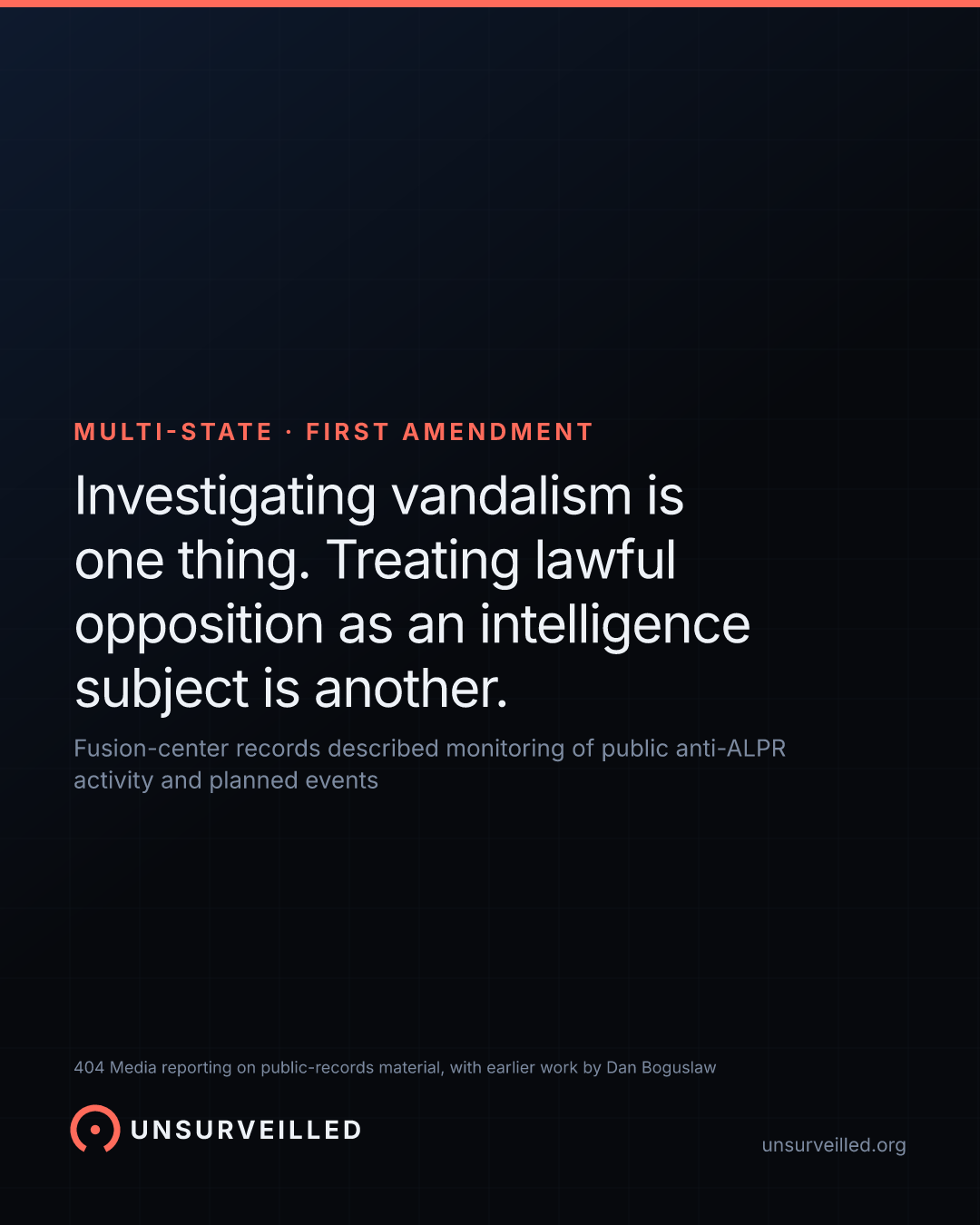
Dark graphic reading "Investigating vandalism is one thing. Treating lawful opposition as an intelligence subject is another." with a smaller line noting that fusion-center records described monitoring of public anti-ALPR activity and planned events.
Unsurveilled graphic, generated from this record. 404 Media reporting on public-records material, with earlier work by Dan Boguslaw. Download the 4:5 version.

What happened

Reporting by 404 Media, building on earlier work by journalist Dan Boguslaw, describes public-records material and intelligence bulletins involving multiple state and regional fusion centers. The records describe monitoring of publicly visible anti-Flock and anti-ALPR social-media activity, the identification of accounts and planned events, and the circulation of intelligence products to law-enforcement recipients. Organizations named in the reporting include the Colorado Information Analysis Center, the Wisconsin Statewide Intelligence Center, the New Jersey State Police, the Central Florida Intelligence Exchange, and the North Florida Fusion eXchange, with wider distribution indicated in related records.

Why it matters

Investigating vandalism is one thing. Treating lawful opposition to government surveillance as an intelligence subject is another. Some of the material described in this reporting concerned actual damage to ALPR equipment, or posts advocating property damage — that is ordinary criminal investigation and nobody should pretend otherwise. But the reporting also describes intelligence products that tracked public meetings, planned events, and organized civic campaigns to end ALPR contracts. Those are core First Amendment activities: speech, association, assembly, and petition. When a system built to detect threats starts producing bulletins about the people trying to end it through ordinary politics, the surveillance debate stops being abstract. It becomes evidence for the thing anti-surveillance advocates have been arguing all along — that capabilities built for one purpose migrate toward whoever is inconvenient.

At a glance

Sourcing
Reported — Reported by a named outlet and not contradicted, but we have not obtained the underlying record. Specifics are presented as reported, not as established.
Story type
Intelligence monitoring
Vendor
Flock Safety
Open questions
5 unresolved

What is established

  • Documented

    Reporting based on public-records material describes fusion centers monitoring publicly visible anti-ALPR social-media activity and circulating intelligence about it to law-enforcement recipients.

    404 MediaDan Boguslaw

  • Documented

    Organizations named in the reporting include the Colorado Information Analysis Center, the Wisconsin Statewide Intelligence Center, the New Jersey State Police, the Central Florida Intelligence Exchange, and the North Florida Fusion eXchange.

    404 Media

  • Documented

    Some of the intelligence material concerned vandalism of ALPR equipment or posts advocating property damage — conduct that is a legitimate subject of criminal investigation.

    404 Media

  • Documented

    Other material described in the reporting concerned lawful political organizing, including public meetings, educational events, and campaigns to end ALPR contracts through ordinary civic process.

    404 Media

What is disputed, contested, or being read too far

  • Unsurveilled analysis

    The widely shared framing that a social platform handed private account data to police is NOT supported by this reporting. What the records describe is monitoring of publicly visible activity. Unless separate evidence establishes platform cooperation, that stronger claim should not be made — and Unsurveilled will not make it.

  • Unsurveilled analysis

    The DeFlock organization and unaffiliated accounts using similar branding are not the same thing. Where source documents distinguish them, that distinction must be preserved rather than collapsed into a single actor.

What the records show

Reporting by 404 Media, building on earlier work by journalist Dan Boguslaw, describes public-records material and intelligence bulletins from multiple state and regional fusion centers.

The material describes:

  • monitoring of publicly visible anti-Flock and anti-ALPR social-media activity,
  • identification of accounts and of planned events,
  • and circulation of intelligence products to law-enforcement recipients.

Organizations named in the reporting include the Colorado Information Analysis Center, the Wisconsin Statewide Intelligence Center, the New Jersey State Police, the Central Florida Intelligence Exchange, and the North Florida Fusion eXchange. Related records indicate wider distribution.

The distinction the viral version dropped

This story reached us the way most stories now do: as a screenshot on X, framed as government surveillance centers are monitoring anti-Flock accounts and feeding information to police.

That framing is close enough to be dangerous. Here is what the reporting supports, stated precisely:

Fusion centers monitored publicly visible anti-ALPR social-media activity and circulated intelligence about that activity and related events to law enforcement.

Here is what it does not support: that Instagram, Meta, TikTok, or any other platform handed private account data to police. Nothing in this reporting establishes that. It is a materially different and much larger allegation, and we are not making it.

If that distinction seems pedantic, consider what happens when it collapses. Every subsequent correction, every agency denial, and every “activists exaggerate” response gets to attach itself to the strongest version of the claim rather than the true one. Precision is not timidity here. It is the only thing that makes the true version survive contact with a press officer.

The line that actually matters

The second distinction is the civil-liberties one, and it is the reason this story ranks as high as it does.

Some of the intelligence activity described concerned actual vandalism of ALPR equipment, or social posts advocating property damage. Investigating property crime and credible threats is what law enforcement is for. Unsurveilled has no quarrel with it — and, as our Apache Junction record makes plain, we do not treat damaging cameras as a legitimate tactic.

But the reporting also describes material tracking lawful political organizing: public meetings, marches, educational events, anti-ALPR campaigns, and communities trying to end contracts through ordinary civic action.

Investigating vandalism is one thing. Treating lawful opposition to government surveillance as an intelligence subject is another.

Speech, association, assembly, and petition are the mechanisms by which a surveillance program is supposed to be contested. A system that produces intelligence bulletins about people using those mechanisms has stopped distinguishing between a threat and an opponent.

We are stating the constitutional concern, not a legal conclusion. Whether any specific act described in this reporting violated the First Amendment is a question for litigation with a full record, and we have neither.

One more distinction

The DeFlock organization and unaffiliated accounts that use similar branding are not the same entity. Where the source documents distinguish them, that distinction has to survive into coverage. Conflating an organization with whoever adopted a similar name online is how a real group ends up answering for posts it never made.

What we still do not have

The strongest possible version of this story rests on the bulletins themselves, obtained and archived, rather than on reporting that describes them. That is our next step, and the open questions above are written as the records requests they should become.

If you have filed such a request, or received a response, we want it: submit evidence.

Receipts

Reported — what does this mean?

Reported by a named outlet and not contradicted, but we have not obtained the underlying record. Specifics are presented as reported, not as established.

  • The government is monitoring anti-Flock TikTok and Instagram accounts404 MediaInvestigative reporting based on public-records material and intelligence bulletins from multiple state and regional fusion centers. Establishes that fusion centers monitored PUBLICLY VISIBLE anti-ALPR social-media activity and circulated intelligence products to law-enforcement recipients. It does NOT establish that any social platform handed over private account data — a distinction that must survive into every headline, caption, and graphic derived from this story.National reporting
  • Exclusive: Government spy hubs are monitoring anti-surveillance activistsDan BoguslawEarlier related reporting on the same body of records. Useful for the sequence and scope of distribution; the underlying bulletins themselves remain the stronger source and have not yet been obtained and archived by Unsurveilled.National reporting

How we found this

A social post is a lead, not evidence. These are listed so the trail is inspectable — the facts above rest on the sources above, not on these.

Not yet obtained

  • The original fusion-center bulletins themselves, obtained and archived rather than described secondhandPublic-records request
  • The full recipient distribution lists for each intelligence productPublic-records request
  • Whether any named individual was placed in a database, watchlist, or ongoing file as a resultPublic-records request
  • What predicate, if any, each fusion center recorded for monitoring lawful organizing as distinct from investigating damagePublic-records request
  • Whether any of the monitored events resulted in a police response, contact, or interview of an organizerPublic-records request

Verified as of

Do this in your town

Find out what your own government operates

An inventory request asks a government to list the surveillance technology it runs. It is the question that opens all the others, and any resident can send it.

Questions this story leaves open

  • The original fusion-center bulletins themselves, obtained and archived rather than described secondhand
  • The full recipient distribution lists for each intelligence product
  • Whether any named individual was placed in a database, watchlist, or ongoing file as a result
This Unsurveilled record is licensed CC BY 4.0. Linked source material remains the property of its publishers. Spotted an error? Tell us — corrections are logged in public, not quietly edited away.