The Norfolk plate-reader case is at the Fourth Circuit, and the whole question is scale

A district judge held that Norfolk's camera grid does not track the whole of a person's movements. Two residents whose cars were captured 475 and 325 times in four months have appealed.

Court documented — what does this mean?

Established by a court filing, opinion, or docket entry rather than by reporting about it.

Event: Published:
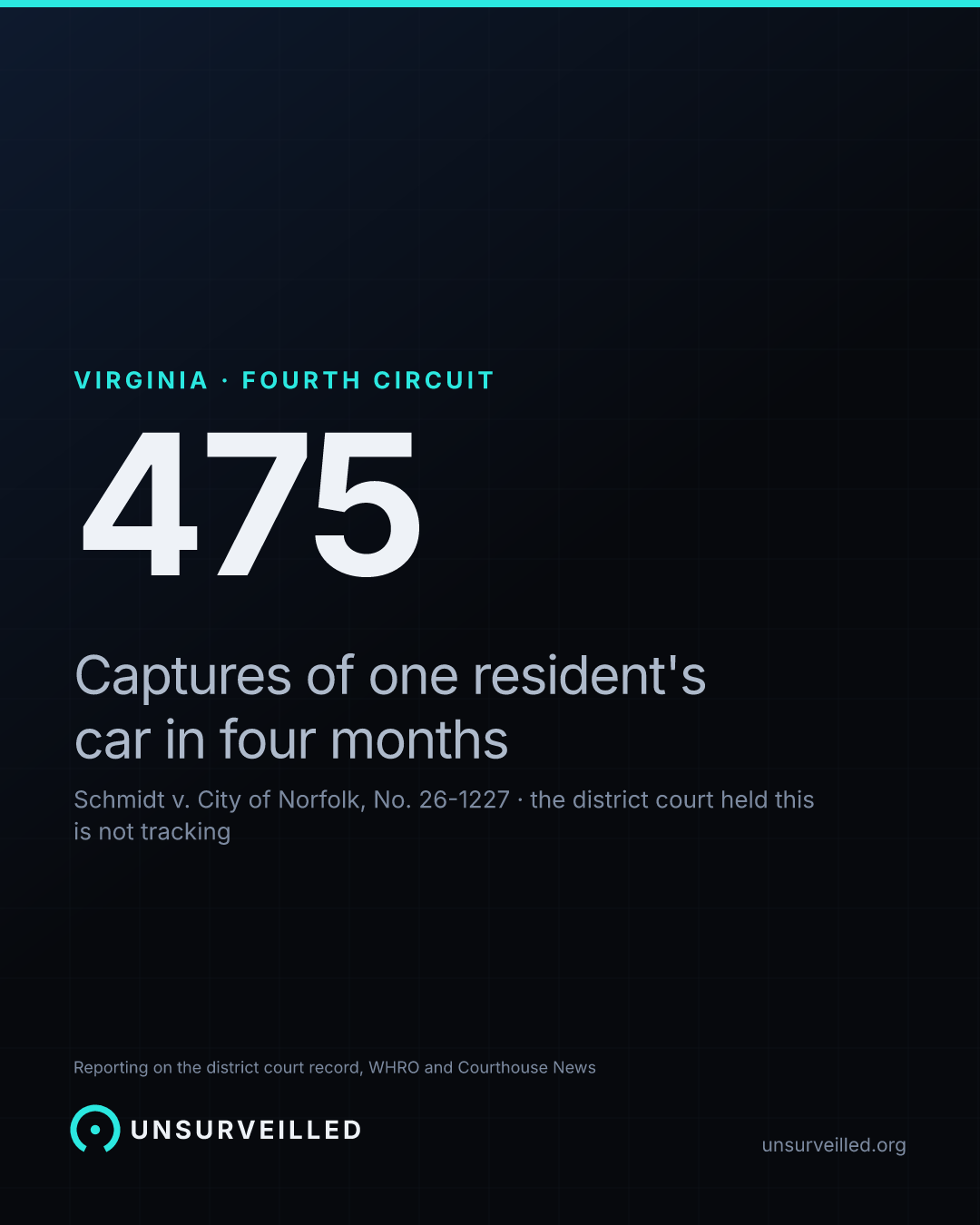
Dark graphic reading 475 above the line "Captures of one resident's car in four months", with a smaller line reading "Schmidt v. City of Norfolk, No. 26-1227, the district court held this is not tracking".
Unsurveilled graphic, generated from this record. Reporting on the district court record, WHRO and Courthouse News. Download the 4:5 version.

What happened

Schmidt v. City of Norfolk is on appeal to the United States Court of Appeals for the Fourth Circuit as No. 26-1227. Norfolk residents Lee Schmidt and Crystal Arrington, represented by the Institute for Justice, sued in October 2024 over the city's Flock camera network. On January 27, 2026 the district court granted summary judgment for the city, reasoning that the plaintiffs had not shown the system capable of tracking the whole of a person's movements and noting the number of camera clusters relative to the city's area. Reporting records that the plaintiffs' vehicles were captured 475 and 325 times respectively over four months in 2025. The appeal has been briefed, with amicus briefs filed in April 2026 by the ACLU together with the ACLU of Virginia and the Electronic Frontier Foundation, and separately by the Cato Institute and the Electronic Privacy Information Center.

Why it matters

Nobody in this case argues that photographing one license plate on one public street is a search. The dispute is entirely about how many cameras, held for how long, searchable how far back, before a collection of individually unremarkable observations becomes something the Fourth Amendment recognises. The district court's answer was essentially arithmetic — a finite number of camera clusters across a city's area cannot capture the whole of anyone's movements, and if investigators need other methods to build a picture then the cameras are not doing the tracking. The plaintiffs' answer is that 475 captures of one car in four months is a picture, whoever assembled it. That is a genuine and unresolved question and this site is not going to pretend it has an obvious answer, because it does not; the appellate courts have not settled it and reasonable judges have gone different ways on adjacent facts. What we will say is that the question is now being asked in a materially different legal landscape than when the district court answered it. The Supreme Court's June 2026 location-data decision reasoned about retrospective and indiscriminate collection in terms that at minimum invite the argument. Whether the Fourth Circuit finds that reasoning transferable is the thing to watch, and it will shape what every city in five states can be told about its cameras.

At a glance

Sourcing
Court documented — Established by a court filing, opinion, or docket entry rather than by reporting about it.
Story type
Lawsuit
Vendor
Flock Safety
Open questions
4 unresolved

What is established

  • Documented

    Lee Schmidt and Crystal Arrington sued the City of Norfolk in October 2024 over its Flock camera network, represented by the Institute for Justice.

    Institute for JusticeCourthouse News Service

  • Documented

    On January 27, 2026 the district court granted summary judgment for the City of Norfolk.

    Courthouse News ServiceWHRO

  • Documented

    The court reasoned that the plaintiffs had not shown the ALPR system capable of tracking the whole of a person's movements, and noted the number of camera clusters relative to the area of greater Norfolk.

    Courthouse News Service

  • Documented

    Reporting on the district-court record states that the plaintiffs' vehicles were captured 475 and 325 times respectively over four months in 2025.

    WHRO

  • Documented

    The case is on appeal to the United States Court of Appeals for the Fourth Circuit as No. 26-1227.

    Electronic Privacy Information Center

  • Documented

    Amicus briefs were filed in April 2026 by the ACLU with the ACLU of Virginia and the Electronic Frontier Foundation, and separately by the Cato Institute and the Electronic Privacy Information Center.

    Electronic Privacy Information Center

What is disputed, contested, or being read too far

  • Disputed

    Whether the reasoning of the Supreme Court's June 2026 location-data decision extends to ALPR networks is contested and unresolved. Civil liberties organisations argue that its treatment of retrospective and indiscriminate collection reaches networked plate readers; Flock and others argue that courts have consistently distinguished ALPR from comprehensive cellphone tracking and that the decision does not address ALPR at all. Both are positions in a live dispute. Neither is a holding.

    Institute for Justice

  • Disputed

    Accounts of the number of cameras in Norfolk's network differ across reporting on this case. We do not state a figure, because the exact count is part of the factual record the appeal turns on and we have not obtained the district court's opinion.

    Courthouse News ServiceWHRO

  • Unsurveilled analysis

    Unsurveilled takes no position on how the Fourth Circuit should rule and makes no prediction about the outcome. Our interest is that the factual record — how many cameras, how long retained, how far back searchable — is accurately reported, because those are the facts every city's argument about its own network rests on.

Where the case stands

Schmidt v. City of Norfolk is on appeal to the United States Court of Appeals for the Fourth Circuit, docketed as No. 26-1227.

Norfolk residents Lee Schmidt and Crystal Arrington sued in October 2024, represented by the Institute for Justice, arguing that the city’s Flock camera network records where they drive in a way the Fourth Amendment does not permit.

On January 27, 2026 the district court granted summary judgment for the city. Its reasoning, as reported: the plaintiffs had not shown the system capable of tracking the whole of a person’s movements, and the number of camera clusters is finite relative to the area of greater Norfolk. The court also reasoned that if other investigative methods are needed to assemble a picture, the cameras cannot be said to be doing the tracking.

The plaintiffs appealed. Amicus briefs were filed in April 2026 by the ACLU with the ACLU of Virginia and the Electronic Frontier Foundation, and separately by the Cato Institute and the Electronic Privacy Information Center — a coalition that does not usually agree about much.

The number the record contains

Over four months in 2025, the network captured the plaintiffs’ vehicles 475 and 325 times.

Both of those things are true at once: each individual capture is a photograph of a car on a public road, which no court has held to be a search; and 475 of them, held and searchable, is a description of where somebody goes.

The case is about whether a court adds them up.

What we are not going to do

We are not going to tell you the district court was obviously wrong.

It might be, and the appellants have serious lawyers and a serious argument. But the question — at what point does an accumulation of individually lawful observations become a search — is genuinely unresolved in the federal courts, judges have gone different ways on adjacent facts, and a site whose entire claim is careful sourcing does not get to substitute confidence for a holding.

We are also not going to predict the outcome, and we are not going to tell you what the Supreme Court’s June 2026 location-data decision means for this appeal.

That last one is contested in a way worth spelling out, because you will see it asserted in both directions with equal certainty:

  • Civil-liberties organisations argue the decision’s reasoning about retrospective, indiscriminate collection reaches networked plate readers, and that a searchable multi-week archive across a camera grid is the same kind of thing it addressed.
  • Flock and others argue the decision does not mention ALPR, that courts including federal appellate courts have consistently distinguished plate readers from comprehensive cellphone tracking, and that nothing has changed.

Those are positions in a live dispute. Neither is a holding. Anyone telling you the Supreme Court settled the ALPR question in June is telling you what they hope, and that includes people we agree with.

What we do have a position on

The factual record.

Every argument a city makes about its own network — that it is limited, that it is targeted, that it does not build a picture — is an argument about how many cameras, retained how long, searchable how far back. Those are not legal questions. They are facts, they are knowable, and in most cities nobody has asked.

That is why the Atlas counts cameras and why every dossier carries retention as its own field with “not established” printed in full when we do not know. Whatever the Fourth Circuit decides, the decision will be applied to networks whose actual dimensions are mostly undocumented, and the documentation is work anyone can do.

We do not hold the district court’s memorandum opinion, which is why the camera count and the retention period applicable during the relevant period are on the open-questions list above rather than in the summary. Reported camera counts for Norfolk’s network differ between accounts, and a number that varies across sources is not a fact yet.

What this changes for a resident

Nothing yet, legally — an appeal is not a rule.

What it changes practically is what your council can be told. Once a circuit speaks, every city in that circuit’s states gets a new sentence to use, in one direction or the other. Knowing your own network’s dimensions before that happens is the difference between participating in the argument and being told how it came out.

The find out what exists guide is where to start, and the records request generator writes the letter.

Receipts

Court documented — what does this mean?

Established by a court filing, opinion, or docket entry rather than by reporting about it.

  • Brief of amicus curiae EPIC, Schmidt v. City of Norfolk, No. 26-1227Electronic Privacy Information CenterA filed brief in the Fourth Circuit appeal, which establishes the docket number and that the appeal is being briefed. An amicus brief is advocacy: it establishes what a party argued, never that the argument is correct.Court filing
  • Judge rules lawsuit challenging Norfolk use of Flock cameras can proceedInstitute for JusticeLitigant material from the organisation representing the plaintiffs. Authoritative about the case history and the plaintiffs position, and not a neutral account of the merits.NGO research
  • The future for license plate readers after the Supreme Court's big Fourth Amendment decisionInstitute for JusticeAn event page from the litigation organisation representing the plaintiffs in Schmidt v. Norfolk, discussing what the Supreme Court's 2026 location-data decision may mean for ALPR systems. Establishes that the question is live and being argued seriously. It is advocacy framing by a party to related litigation, and it is not a holding.NGO research
  • Judge holds Norfolk license plate reader use constitutionalCourthouse News ServiceReports the January 27, 2026 summary-judgment ruling for the City of Norfolk, and the court reasoning that the plaintiffs had not shown the system capable of tracking the whole of a person movements. Reporting about an opinion, not the opinion itself; Unsurveilled has not obtained the memorandum opinion and does not quote from it.Local reporting
  • A federal judge ruled Norfolk Flock surveillance cameras do not invade people privacy — yetWHROAdds detail on the record before the district court, including that the two plaintiffs vehicles were captured 475 and 325 times over four months in 2025, and the court observation about the number of camera clusters relative to the city area. Camera counts differ between accounts of this case, so no single figure is stated as established.Local reporting

Not yet obtained

  • Has oral argument been scheduled in No. 26-1227?Court record
  • How many ALPR cameras did Norfolk operate during the period at issue, per the district court record?Court record
  • What retention period applied to Norfolk's data during the period at issue?Court record
  • Does the district court's memorandum opinion address retention and searchability separately from camera count?Court record

Verified as of

Do this in your town

Find out what your own government operates

An inventory request asks a government to list the surveillance technology it runs. It is the question that opens all the others, and any resident can send it.

Questions this story leaves open

  • Has oral argument been scheduled in No. 26-1227?
  • How many ALPR cameras did Norfolk operate during the period at issue, per the district court record?
  • What retention period applied to Norfolk's data during the period at issue?
This Unsurveilled record is licensed CC BY 4.0. Linked source material remains the property of its publishers. Spotted an error? Tell us — corrections are logged in public, not quietly edited away.