Supreme Court holds digital location history is protected — and says nothing about license plate readers

Chatrie v. United States is the most important Fourth Amendment decision in eight years. It is also not the ALPR ruling some coverage is treating it as, and the difference matters if you are about to quote it to a city council.

Court documented — what does this mean?

Established by a court filing, opinion, or docket entry rather than by reporting about it.

Event: Published:
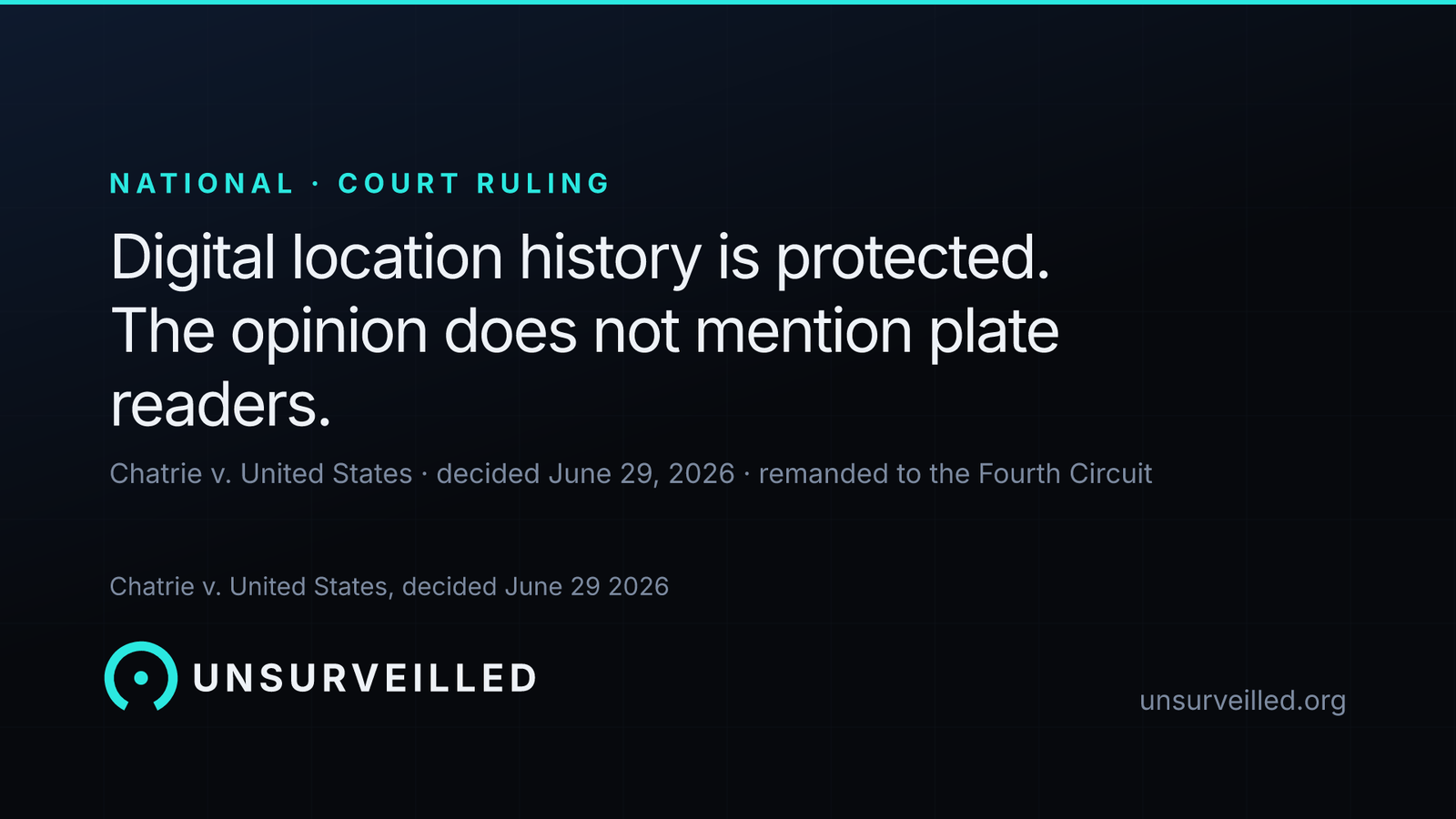
Dark graphic reading "Digital location history is protected. The opinion does not mention plate readers." with a smaller line reading "Chatrie v. United States, decided June 29, 2026, remanded to the Fourth Circuit".
Unsurveilled graphic, generated from this record. Chatrie v. United States, decided June 29 2026. Download the 4:5 version.

What happened

On June 29, 2026, the Supreme Court decided Chatrie v. United States, holding that individuals retain a reasonable expectation of privacy in digital location data even for short periods and even when a third party holds it, so obtaining it is a Fourth Amendment search. Justice Kagan wrote for the Court. The case arose from a geofence warrant served on Google after a 2019 credit union robbery in Virginia. The Court did not decide whether that particular warrant satisfied probable cause and particularity, remanding to the Fourth Circuit, and the opinion does not address automated license plate readers.

Why it matters

The reasoning is what makes this consequential rather than the outcome. The Court looked at the retrospective and indiscriminate character of the collection and at what sat in the database as a whole, not merely at the narrow slice police actually pulled. Every one of those adjectives describes a networked ALPR system. That is why civil-liberties lawyers think the logic travels, and they may well be right. But "may well be right" is not a holding, and this is exactly the point where an advocacy organisation can destroy its own credibility in a single sentence. Courts have so far upheld warrantless fixed ALPR use with near-uniformity — a federal appellate panel held as recently as March 2026 that a roughly ten-camera system was not a search because it produced only periodic glimpses rather than the whole picture. If you stand up at a council meeting and say the Supreme Court ruled license plate readers unconstitutional, the city attorney will correct you in public and everything else you say that night will be discounted. Say what the Court actually held. It is strong enough.

At a glance

Sourcing
Court documented — Established by a court filing, opinion, or docket entry rather than by reporting about it.
Story type
Court ruling
Open questions
4 unresolved

What is established

  • Documented

    The Supreme Court decided Chatrie v. United States on June 29, 2026, after argument on April 27, 2026. Justice Kagan delivered the opinion of the Court.

    Supreme Court of the United StatesJustia

  • Documented

    The Court held that individuals retain a reasonable expectation of privacy in digital location data, even for short periods and even though a third party holds that data, so obtaining it is a Fourth Amendment search.

    Supreme Court of the United States

  • Documented

    The Court did NOT decide whether the geofence warrant in the case satisfied the Fourth Amendment's probable cause and particularity requirements, and remanded to the Fourth Circuit.

    Supreme Court of the United StatesJustia

  • Documented

    The case arose from a geofence warrant served on Google seeking devices within a 150-metre radius of a Midlothian, Virginia credit union around the time of a May 2019 robbery.

    Justia

  • Documented

    The opinion does not address automated license plate readers.

    Supreme Court of the United States

  • Documented

    In March 2026, in United States v. Porter, the Fifth Circuit held that police use of a roughly ten-camera license plate reader system was not a Fourth Amendment search because it provided only periodic information about movement rather than the whole picture.

    The Record (Recorded Future News)

What is disputed, contested, or being read too far

  • Disputed

    Whether Chatrie's reasoning extends to networked ALPR systems is contested and unresolved. Civil-liberties advocates argue the Court's focus on retrospective, indiscriminate collection and on the contents of the database as a whole applies directly. Flock Safety's position is that courts have repeatedly and uniformly treated ALPR differently from cell location data. Both are litigating positions. Neither is a holding.

    The Record (Recorded Future News)

  • Unsurveilled analysis

    Some coverage has characterised this as a decision about license plate cameras. It is not. Reading it that way will get an advocate corrected in public by a city attorney, and Unsurveilled will not repeat the framing.

The holding

On June 29, 2026, the Supreme Court decided Chatrie v. United States. Justice Kagan wrote for the Court.

The case came out of a geofence warrant. After a May 2019 robbery at a credit union in Midlothian, Virginia, police obtained a warrant directed at Google for location data on every device within a 150-metre radius around the time of the crime.

The Court held that individuals retain a reasonable expectation of privacy in their digital location data — even for short periods, and even though a third party holds it. Obtaining it is therefore a Fourth Amendment search.

The government had argued that a short time window put the data outside Fourth Amendment protection. The Court rejected that, reasoning that even brief location history can reveal visits to indisputably private places — a psychiatrist’s office, a clinic.

What the Court explicitly did not decide

Two things, and both matter.

It did not decide whether this warrant was valid. Whether the geofence warrant satisfied probable cause and particularity was left open and remanded to the Fourth Circuit. The Court decided that the Fourth Amendment applies, not that it was violated.

It said nothing about automated license plate readers. The opinion does not address them. There is no ALPR holding in this case.

Why we are being this pedantic

Because the alternative loses arguments.

Some coverage of this decision has run under headlines about license plate cameras. If you take that framing into a council meeting and say the Supreme Court has ruled ALPRs unconstitutional, the city attorney will correct you in front of everyone, and every accurate thing you said that night gets discounted along with it.

The current state of ALPR case law is genuinely unfavourable and we are not going to pretend otherwise. State and federal courts have upheld warrantless fixed ALPR use with near-uniformity. As recently as March 2026, in United States v. Porter, the Fifth Circuit held that a roughly ten-camera system was not a search at all, on the reasoning that it produced periodic glimpses rather than a whole picture.

Our formulation on The Law is deliberate and we do not exceed it:

Warrantless mass ALPR surveillance violates the principles and protections of the Fourth Amendment.

Principles and protections. Not “is unconstitutional,” not “the Supreme Court has ruled.” Those would be stronger sentences and we could not defend either.

Why it is still a big deal

The reasoning.

The Court looked at the retrospective and indiscriminate character of the collection, and at what was sitting in the database as a whole rather than only the slice police pulled out of it.

Hold that up against a networked ALPR system. Retrospective: the database exists before anyone is a suspect and is searched backwards in time. Indiscriminate: every passing vehicle, without regard to suspicion. And the whole-database framing is the direct answer to Porter’s “only periodic glimpses” reasoning — because ten cameras in one town are not the system. The system is the network, and the network is national.

That is a real argument, it is now anchored in a Supreme Court opinion, and civil-liberties lawyers are already making it. Flock’s position is that courts have consistently distinguished ALPR from cell location data.

Both are positions in a live dispute. Neither is settled. That is the honest state of the law, and it is a much better position than advocates were in twelve months ago.

What to actually say

If you are speaking at a meeting or writing to an official, this is defensible in full:

In June the Supreme Court held that obtaining digital location history is a Fourth Amendment search, even over short periods and even when a company holds the data. The Court’s reasoning turned on collection that is retrospective and indiscriminate. Our license plate reader network is both. The Court has not decided whether that reasoning covers license plate readers, and I am not claiming it has. I am asking why this city is choosing to sit on the unresolved side of that question when it could adopt a warrant requirement itself.

That last sentence is the ask. A council does not have to wait for a court to tell it what the floor is — it can set one. That is what Warrant Required asks for, and this decision makes the ask considerably harder to wave away.

Receipts

Court documented — what does this mean?

Established by a court filing, opinion, or docket entry rather than by reporting about it.

  • Chatrie v. United States, No. 25-112 (U.S. June 29, 2026)Supreme Court of the United StatesThe opinion itself, Kagan J. Establishes that a Fourth Amendment search occurs when the government obtains digital location history held by a third party, even for a short period. It expressly does NOT resolve whether the geofence warrant in the case satisfied probable cause and particularity — that was remanded to the Fourth Circuit — and it says nothing about automated license plate readers.Court opinion
  • The future for license plate readers after the Supreme Court's big Fourth Amendment decisionInstitute for JusticeAn event page from the litigation organisation representing the plaintiffs in Schmidt v. Norfolk, discussing what the Supreme Court's 2026 location-data decision may mean for ALPR systems. Establishes that the question is live and being argued seriously. It is advocacy framing by a party to related litigation, and it is not a holding.NGO research
  • Chatrie v. United States, 609 U.S. ___ (2026)JustiaCase summary and procedural history; argued April 27, 2026.Court opinion
  • License plate cameras may be next target after Supreme Court reins in location trackingThe Record (Recorded Future News)Reports the argument that Chatrie's reasoning about retrospective and indiscriminate collection could extend to ALPR networks, and Flock's counter-position that courts have consistently treated ALPR differently. Both are positions in a live dispute, not holdings.National reporting

Not yet obtained

  • How the Fourth Circuit resolves probable cause and particularity on remandCourt record
  • Whether any court has yet applied Chatrie's reasoning to an ALPR system, and with what resultCourt record
  • Whether the Court's reasoning distinguishes systems by scale, retention, or network breadth in a way that maps onto ALPR deploymentsCourt record
  • Whether any state supreme court reaches the ALPR question first under a state constitutionCourt record

Verified as of

Do this in your town

Understand what it does and does not hold

Quoting a decision beyond what it holds is the fastest way to lose a council room. Read the limits before you cite it, then ask your agency what standard it actually applies.

Questions this story leaves open

  • How the Fourth Circuit resolves probable cause and particularity on remand
  • Whether any court has yet applied Chatrie's reasoning to an ALPR system, and with what result
  • Whether the Court's reasoning distinguishes systems by scale, retention, or network breadth in a way that maps onto ALPR deployments
This Unsurveilled record is licensed CC BY 4.0. Linked source material remains the property of its publishers. Spotted an error? Tell us — corrections are logged in public, not quietly edited away.