Flock cuts default ALPR retention from 30 days to seven — and still does not require a warrant

The largest ALPR vendor in American policing announced real, substantial limits on its own product. It also left the one question this campaign is about exactly where it was.

Primary document — what does this mean?

We hold or directly cite the underlying record — a contract, ordinance, policy, procurement file, or public-records response.

Event: Published:
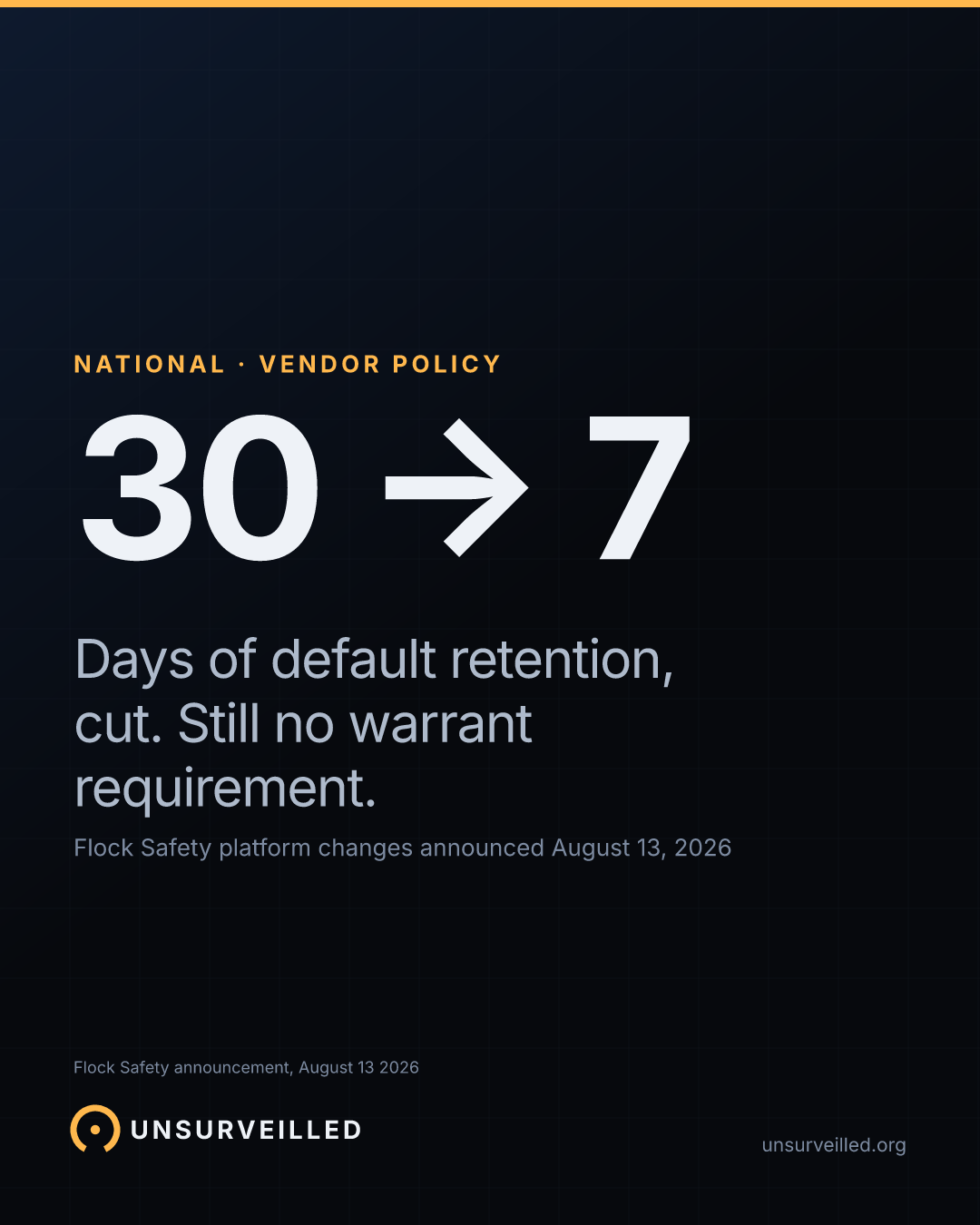
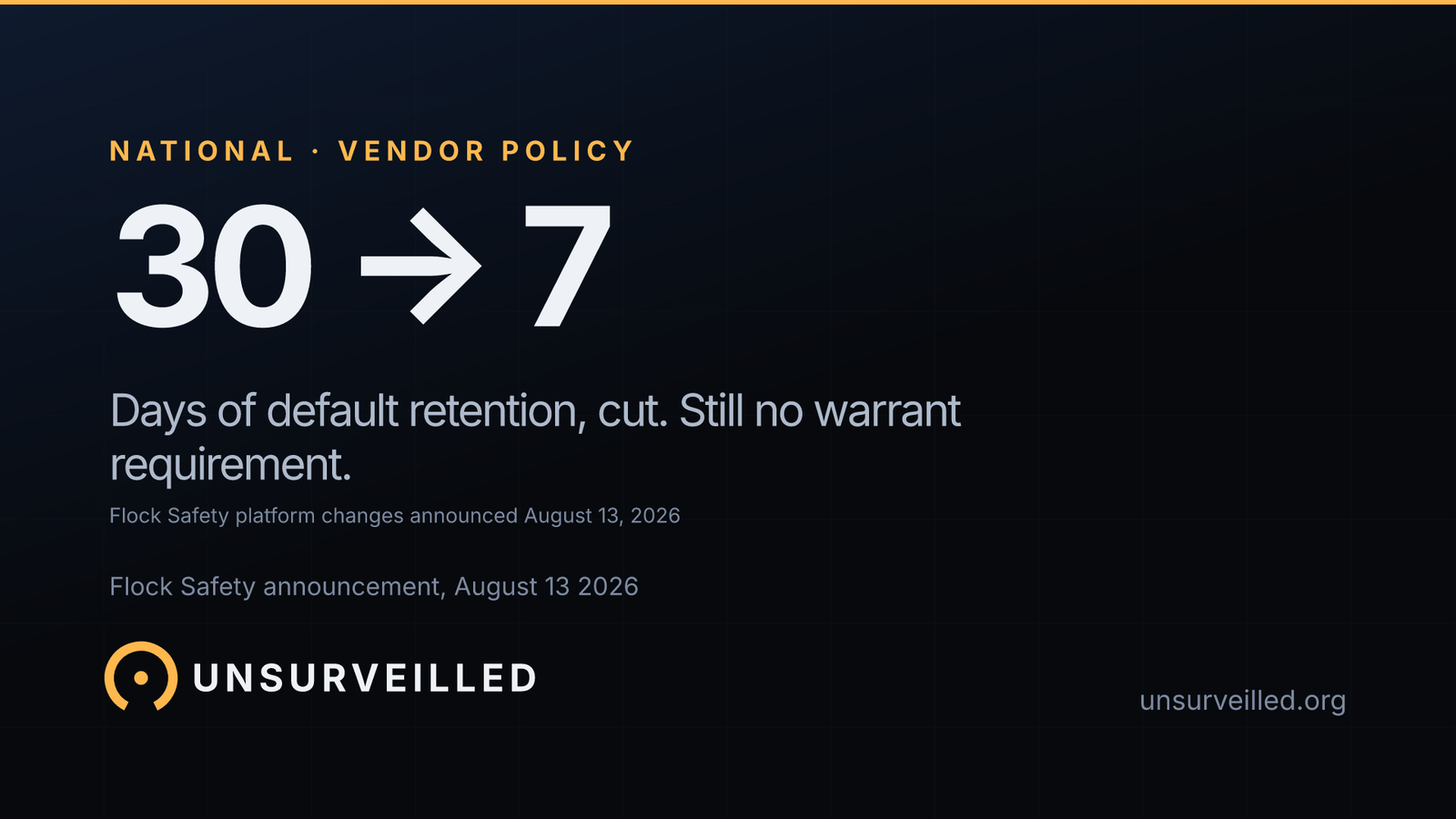
Dark graphic reading "30 to 7" above the line "Days of default retention, cut. Still no warrant requirement.", with a smaller line reading "Flock Safety platform changes announced August 13, 2026".
Unsurveilled graphic, generated from this record. Flock Safety announcement, August 13 2026. Download the 4:5 version.

What happened

On August 13, 2026, Flock Safety announced a package of changes to its automated license plate reader platform: the default data retention period drops from 30 days to seven, all law-enforcement searches must carry a case code by the end of 2026, exigent searches that bypass the requirement are flagged for administrator review, audit-monitoring tooling becomes mandatory for agencies by end of 2026, and a new "Evidence Mode" lets investigators preserve specific records tied to an open case. Flock says over 90% of searches without a full plate happen within a week. The announcement contains no warrant requirement.

Why it matters

Take the retention change seriously: it is the single field that most changes what an ALPR system is, and cutting the default from 30 days to seven is a real reduction in the size of the movement archive. A company does not do that because things are going well. Fifty-odd jurisdictions walking away, an audit-driven shutdown in Chandler, a sheriff citing the Fourth Amendment in Pinal County, and a Supreme Court that just held location history is protected are all pressure, and the pressure produced a concession. But read what the concession is. A case code is typed by the officer running the search. Nothing in the announcement validates it against a real, open, relevant case at the moment of the query — it produces an audit trail after the fact, which is useful, and it is not a legal standard applied before the fact, which is what a warrant is. Flock has moved the retention dial and improved oversight while leaving untouched the question of what an officer must show before searching a database of people suspected of nothing. That is precisely the gap Warrant Required exists to close, and this announcement is the clearest evidence yet that the industry will move on everything else first.

At a glance

Sourcing
Primary document — We hold or directly cite the underlying record — a contract, ordinance, policy, procurement file, or public-records response.
Story type
Vendor policy
Vendor
Flock Safety
Open questions
6 unresolved

What is established

  • Documented

    Flock Safety announced on August 13, 2026 that its default data retention period drops from 30 days to seven days.

    Flock SafetyThe Washington Post

  • Documented

    By the end of 2026, law-enforcement users will be required to enter a case code before running a search.

    Flock SafetyCNN Business

  • Documented

    Searches conducted under exigent circumstances may bypass the case-code requirement, and every such search is flagged for administrator review.

    Flock Safety

  • Documented

    Audit Assistance, which detects abnormal activity, becomes mandatory for agencies by the end of 2026, alongside a proactive lockout that suspends access when behaviour meets abuse criteria pending administrator review.

    Flock Safety

  • Documented

    A new "Evidence Mode" allows investigators to preserve specific records in cold storage for active investigations, free to customers who adopt the seven-day default.

    Flock Safety

  • Official claim

    Flock states that over 90% of searches without a full plate are performed within a week of the scan.

    Flock Safety

  • Documented

    The announcement does not commit to any warrant or court-order requirement for access to ALPR data.

    Flock Safety

What is disputed, contested, or being read too far

  • Disputed

    A case code is entered by the officer running the search. Reporting notes that nothing validates the code against a genuine, relevant, open case at the time of the query, which would make it an audit artefact rather than a pre-search legal standard. Unsurveilled has not independently tested the system, so we present this as reported analysis rather than as an established property of the product.

    Tech Times

  • Unsurveilled analysis

    Whether a seven-day default meaningfully reduces risk depends entirely on adoption. It is a default, not a floor — the announcement does not say agencies are prevented from configuring longer retention, and Unsurveilled has not established what the ceiling is.

What was announced

On August 13, 2026, Flock Safety published a package of changes to its automated license plate reader platform. In the company’s own words, the headline items are:

  • Default retention cut from 30 days to seven. Flock justifies this with a statistic about its own product: over 90% of searches without a full plate happen within a week of the scan.
  • Case codes required on every search by the end of 2026.
  • Exigent searches may bypass the code, but every one is flagged for administrator review.
  • Audit Assistance mandatory for agencies by end of 2026, detecting abnormal activity, plus a proactive lockout that suspends access when behaviour meets abuse criteria.
  • Evidence Mode, letting investigators preserve specific records in cold storage for an open case — free to customers who adopt the seven-day default.
  • Plain-English contract summaries, promised for the following week.

Give the retention change its due

Retention is the field that most changes what an ALPR deployment actually means. We say that on every jurisdiction dossier on this site, and we do not get to stop saying it when a vendor moves in the right direction.

Thirty days of every vehicle movement a city’s cameras observe, searchable, is a movement archive. Seven days is much closer to an operational tool. Same hardware, same cameras, materially different capability — and the difference is measured in what a future official could reconstruct about where you have been.

Flock did not do this because things were going well. The context is a bad year: Chandler shut down 40 cameras after its own audit found use it could not explain, a Pinal County sheriff declined renewal on Fourth Amendment grounds, a Rhode Island town council cancelled outright, and the Supreme Court held in June that digital location history is protected by the Fourth Amendment even over short periods.

Sustained public pressure produced a concession from the market leader. That is worth recording plainly, and it is worth the organisers who did it knowing that it worked.

Now read what is absent

There is no warrant requirement anywhere in the announcement.

That is not an oversight, and it is not a small remaining detail. It is the whole question. Every other control Flock announced governs how the tool is administered. None of them governs what an officer must show before searching a database of people suspected of nothing.

Consider the case-code requirement, which is the change most likely to be read as a warrant substitute. Reporting on the announcement makes the point sharply: the code is entered by the officer running the search. On the available information, nothing validates it against a real, open, relevant case at the moment the query executes. It creates a record that can be audited afterwards — genuinely useful, as Chandler demonstrated — but an audit is a thing that happens after a search, and a warrant is a thing that happens before one.

We have not tested the product, so we are careful here: it is possible that agency deployments validate codes against a records management system in ways the announcement does not describe. That is one of the open questions above, and we would publish a correction gladly.

The pattern this establishes

An industry under pressure will move on retention, on audit logging, on dashboards, on transparency portals, and on plain-English contracts before it will move on the legal standard for access.

Every item on that list is easier to concede, because every item leaves intact the thing the product is for: an officer, deciding alone, can still search where you have been. Improve the audit trail and you improve the odds of catching one who abused it afterwards. Require a warrant and you change who gets to make the decision in the first place.

That is why Warrant Required is written the way it is, and why it is aimed at a legal standard rather than at a company. This announcement is the strongest evidence yet for that framing: the company moved, substantially, on everything except the standard.

What this changes for a resident

If your city runs Flock cameras, this week produced three concrete questions worth putting to your council in writing:

  1. Has our agency adopted the seven-day default, and by what date? It is a default, not a mandate, and defaults can be overridden.
  2. Are case codes validated against our records management system, or simply recorded? The answer determines whether this is oversight or paperwork.
  3. Does any of this change our sharing configuration? Retention governs how long we keep data. It says nothing about who else already has it.

The records request generator covers all three.

Receipts

Primary document — what does this mean?

We hold or directly cite the underlying record — a contract, ordinance, policy, procurement file, or public-records response.

  • Flock updates privacy, accountability, security, and transparency safeguardsFlock SafetyThe company's own announcement, and therefore authoritative for what Flock says it will do: default retention cut from 30 days to 7, case codes required on all searches by end of 2026, exigent searches flagged for administrator review, Audit Assistance mandatory by end of 2026, proactive lockout, and Evidence Mode free to agencies adopting the 7-day default. It is NOT authoritative for whether those measures work, whether agencies will adopt them, or whether they are sufficient. Note what is absent: no warrant requirement for access is announced anywhere in it.Vendor material
  • Flock announces changes amid backlash over its license plate reader networkThe Washington PostNational coverage of the August 2026 Flock platform changes, placing them against the run of cancellations that preceded them. Establishes that the changes were announced and that they followed sustained public pressure. Its account of what the product now does rests on Flock's own announcement, which remains the primary source for the product behaviour itself.National reporting
  • Flock rolls out new police auditing and accountability controls following surveillance concernsCNN BusinessNational coverage of the same announcement, focused on the auditing and case-code controls. Establishes what was announced. It does not establish that any agency has adopted the controls, nor that a case code is validated against a genuine open case at the moment a search runs — which is the question that separates an audit trail from a legal standard.National reporting
  • Flock Safety sets 7-day default for ALPR data, adds mandatory misuse safeguardsPolice1Trade coverage aimed at law enforcement readers, useful for how the changes are being presented to the agencies that have to implement them.National reporting
  • Flock Safety reforms leave the warrant gap open — officers can type any case numberTech TimesMakes the distinction this story turns on: a case code is entered by the searching officer and is not validated against anything at the moment of search, so it is an audit artefact rather than a legal standard. We have not independently tested the system, so this is presented as reported analysis.National reporting

Not yet obtained

  • Can an agency still configure retention longer than seven days, and what is the maximum?Vendor disclosure
  • Is a case code validated against the agency's records management system at search time, or merely recorded?Vendor disclosure
  • How many agencies have actually adopted the seven-day default, and by when must they?Vendor disclosure
  • Does the retention change apply retroactively to data already collected?Vendor disclosure
  • What is the exigent-circumstances definition, and who reviews the flagged searches?Vendor disclosure
  • Do these changes alter the default sharing configuration between agencies, or only retention and audit?Vendor disclosure

Verified as of

Do this in your town

Ask what your local contract actually configures

A vendor default is not a local setting. Ask your agency for its current configuration in writing rather than assuming the announcement applies where you live.

Questions this story leaves open

  • Can an agency still configure retention longer than seven days, and what is the maximum?
  • Is a case code validated against the agency's records management system at search time, or merely recorded?
  • How many agencies have actually adopted the seven-day default, and by when must they?
This Unsurveilled record is licensed CC BY 4.0. Linked source material remains the property of its publishers. Spotted an error? Tell us — corrections are logged in public, not quietly edited away.