X
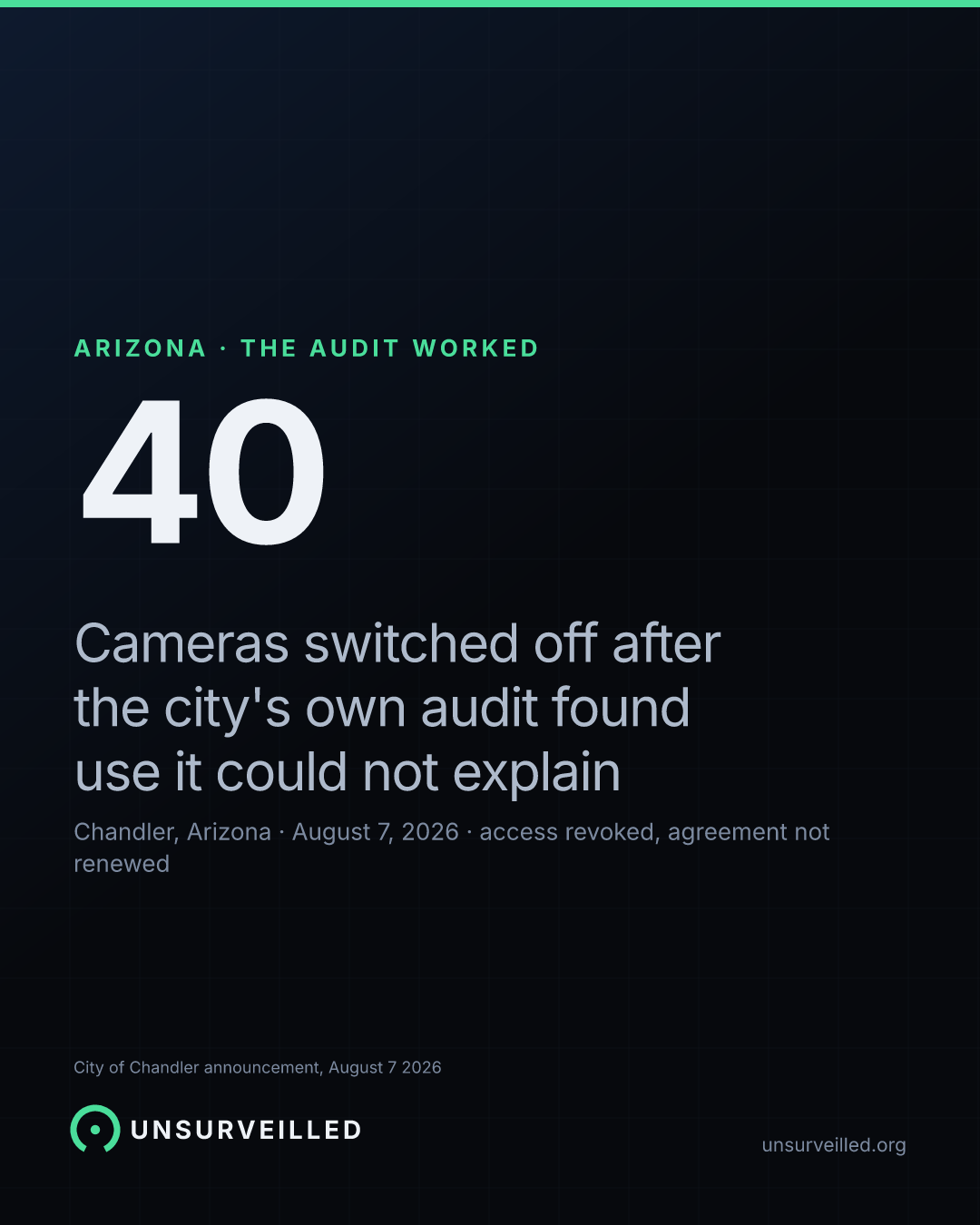
Chandler PD ran ALPR audits for three years and found nothing. The fourth audit found use nobody could explain. The city did not tighten the policy — it revoked every officer's access and ended the program. 40 cameras, gone. Every source →
Three years of routine audits found nothing. The fourth found something. The largest Arizona city running Flock Safety cameras responded by revoking every officer's access and ending the program outright.
Stated by the government body itself — a press release, council record, or agency statement. Authoritative about what the agency says, which is not the same as independently verified.
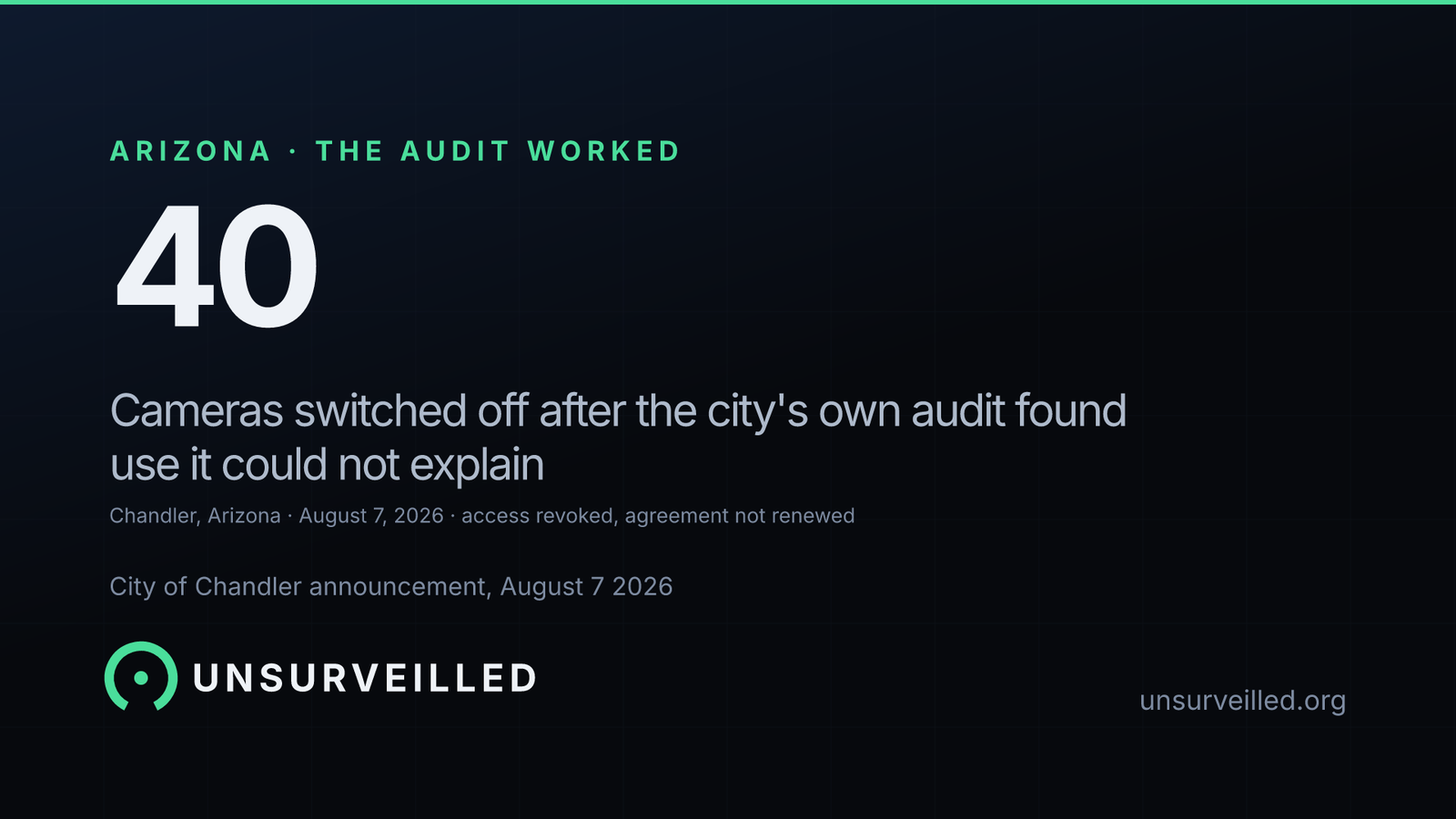
On August 7, 2026 the City of Chandler announced it would discontinue its use of Flock Safety automated license plate readers after a routine audit at the Chandler Police Department identified an anomaly in system use that could not be explained by standard police action. The police chief described it as potential misuse by someone inside the department. The city cut all departmental access, discontinued all 40 cameras, and did not renew the service agreement.
The significant detail is not that misuse happened. It is that Chandler had been running audits for three years before one caught anything — and then that the city's response was to stop rather than to tighten controls and carry on. Both halves matter. The first is the strongest available argument against "we audit it, so it is fine": an audit regime that works is also a regime that ran for three years without surfacing this, which leaves open how much went undetected before. The second is the part every council considering the same technology should be asked about directly. Chandler's department found the problem itself, and Chandler's conclusion was that the capability was not worth keeping. That is a precedent with a specific, citable date attached, and it is roughly twenty miles from every other East Valley council chamber.
The City of Chandler announced on August 7, 2026 that it would discontinue use of Flock Safety automated license plate readers.
A routine audit identified an anomaly in ALPR use that could not be explained by standard police action.
All 40 cameras were discontinued, the service agreement was not renewed, and access was revoked for every member of the department.
The police chief characterized the finding as potential misuse by someone inside the department, and an internal investigation was ongoing at the time of the announcement.
The city stated that its initial review made clear no Chandler resident or member of the public had their privacy compromised. That is the city's characterization of an investigation it had not yet completed. We present it as the city's position, not as an established fact.
On August 7, 2026, the City of Chandler announced it was discontinuing its use of Flock Safety automated license plate readers.
A routine audit at the Chandler Police Department had identified an anomaly in license-plate-reader use that could not be explained by standard police action. According to the city, it was the first such finding in three years of audits. The chief described it as potential misuse by someone inside the department.
The city’s response was total: all 40 cameras discontinued, the service agreement not renewed, and access revoked for every member of the department — not merely the individual involved. The city also committed to policy revision, additional audit procedures, and new reporting requirements. An internal investigation was ongoing when the announcement was made.
Almost every council presentation for this technology contains a version of the sentence “the system is audited.”
Chandler is what that sentence looks like when you follow it all the way through, and it cuts in two directions at once. Both are worth stating plainly, because a case that only supported one of them would be less useful:
The audit worked. Nobody complained. No victim came forward. No journalist broke it. The department’s own process surfaced the problem. That is a genuine point in favour of audit requirements, and we are not going to pretend otherwise.
The audit took three years to surface anything. Which leaves an obvious and unanswered question about the period before it. An audit regime that eventually catches something is not the same as an audit regime that catches things promptly, and the difference is measured in how long a searchable history of ordinary people’s movements sat there un-scrutinized.
What makes this a precedent rather than an incident is Chandler’s conclusion.
The department did not respond by tightening controls, adding a second approval step, and carrying on. It stopped.
That is the question every neighbouring council should now be asked directly: Chandler’s own audit found something, and Chandler decided the capability was not worth keeping. What did your chief conclude, and on what evidence?
Chandler is the largest Arizona city to end a Flock partnership. It is also within about twenty miles of most of the other East Valley councils, all of which watch each other. Two days before this announcement, the Pinal County Sheriff declined to renew his own Flock contract on Fourth Amendment grounds.
The city’s statement that no resident’s privacy was compromised is the city’s position on an investigation that was still open at the time. We record it as the city’s account, not as fact.
We also do not hold the audit report, the outcome of the internal investigation, the disposition of data already collected and shared, or the three prior years of audits that found nothing. Every one of those is obtainable through a public records request, and every one is listed above.
The most important of them is the last: whether Chandler retains access to any regional or neighbouring ALPR database. Ending a contract and ending a capability are different things — as Austin demonstrated when its Flock cancellation was followed by continued ALPR use through a different vendor. Until that question is answered, Chandler’s shutdown is a decision about a vendor, not necessarily a decision about mass license-plate surveillance.
Stated by the government body itself — a press release, council record, or agency statement. Authoritative about what the agency says, which is not the same as independently verified.
Not yet obtained
Verified as of
Check what a cancellation near you actually ended
A cancelled contract is not always an ended capability. Ask whether hardware was removed, access disabled, collected data deleted, and whether a different vendor has since arrived.
Questions this story leaves open
This story concerns Chandler, Arizona, where we hold a dossier listing what is documented, what is not, and the requests that would close the gaps.
This Unsurveilled record is licensed CC BY 4.0. Linked source material remains the property of its publishers. Spotted an error? Tell us — corrections are logged in public, not quietly edited away.